- AI visibility in 2026 means more than ranking on Google — your brand needs to appear inside AI-generated answers from ChatGPT, Gemini, Claude, and Perplexity to stay competitive.
- LLM SEO, LLM Seeding, and AI SEO are three distinct strategies — each targeting a different part of the AI-driven search ecosystem, and confusing them leads to wasted effort.
- LLM Seeding focuses on training AI models to associate your brand with specific topics by distributing authoritative content across high-trust sources — not just your own website.
- The smartest brands are combining all three approaches — using AI SEO to work faster, LLM Seeding to build brand signals, and LLM SEO to get cited in answers.
- Keep reading to find out which strategy fits your specific business situation — and how to know if AI assistants are already mentioning (or ignoring) your brand.
The rules of digital visibility just changed, and most marketers haven’t caught up yet.
For a long time, the strategy was clear: achieve a higher ranking on Google, get more clicks, secure more business. That approach still works — but it’s no longer the entire story. AI assistants such as ChatGPT, Gemini, Claude, and Perplexity are now responding to millions of inquiries each day without directing users to a search results page. If your brand isn’t appearing within those responses, you’re invisible to a rapidly expanding portion of your audience. LLM Seeding is one of the frameworks that are emerging to address this issue, assisting brands in developing the type of AI-recognized authority that results in them being cited, not just ranked.
Google Rankings Don’t Tell the Whole Story
This isn’t about Google losing relevance — it’s about the information environment growing beyond what Google alone can encompass. Search behavior is diversifying. Younger audiences especially are using AI chat interfaces to get immediate, consolidated answers instead of scrolling through ten blue links. The trend is quantifiable and speeding up.
How AI Assistants Are Revolutionizing Information Discovery
When a person asks ChatGPT “what’s the best project management software for remote teams,” they receive a structured response with specific recommendations — and no search results page. The brands mentioned in that response didn’t end up there by chance. They’re there because AI models, which have been trained on vast datasets of web content, have learned to associate these brands with reliability and relevance to that specific topic. This is a radically different process than ranking for a keyword.
Every day, Gemini, Claude, and Perplexity follow the same pattern. They use training data, real-time web access, high-authority sources, and structured signals to determine what to highlight. The question is no longer “do I rank?” — it’s “does the AI recognize me and trust me enough to suggest me?”
Why Traditional SEO Metrics are Outdated in 2026
Conventional SEO metrics like organic traffic, click-through rate, and keyword rankings do not take into account AI-driven visibility. A brand may be recommended consistently by ChatGPT to thousands of users without a single click that can be tracked. This is how the citation economy works. Visibility is occurring, influence is being wielded, and purchasing decisions are being influenced, all without appearing on the analytics dashboard that most marketers monitor.
Many brands think their SEO is performing well even though their growth has stagnated. This is because there’s a gap between where visibility is happening and where it’s being measured. The audience has moved on, but the strategy hasn’t.
Understanding LLM SEO
LLM SEO is all about tailoring your content and brand image to gain mentions in AI-created responses. This differs from conventional SEO as it’s not about trying to appeal to a search engine algorithm, but rather about making your content appealing to large language models, ensuring that they view it as reliable and choose to include it in their generated answers.
Aim: To be Included in AI-Generated Responses
The primary goal is simple: when a user asks a question related to your field to an AI assistant, your brand, product, or content should be included in the response. This requires content that is clearly structured, rich in facts, and formatted in a way that AI models can easily understand and refer to. Thin content, vague claims, and keyword-stuffed paragraphs don’t serve LLMs — they serve outdated ranking signals.
LLM SEO content is typically clear, well-structured, and authoritative. It answers questions fully, uses specific data points, and is structured in such a way that even if a language model extracts a snippet, it can accurately represent the original intent.
Defining Success: Mentions, Citations, and Share of Voice
Since AI citations don’t always lead to clicks, the metrics for success tend to lean more towards how often your brand is mentioned, your share of voice in AI-generated responses, and a qualitative review of how AI assistants talk about your brand. While tools to track AI mentions are starting to appear, many teams are currently using manual prompt testing across ChatGPT, Gemini, and Perplexity to establish their baseline for AI visibility.
Understanding the AI Systems Targeted by LLM SEO: ChatGPT, Gemini, Claude, and Perplexity
Every major AI assistant has its own unique set of training sources, retrieval methods, and citation behaviors. For instance, ChatGPT (particularly when Browse is enabled) draws from real-time web content and its trained data. Perplexity, on the other hand, is explicitly search-augmented and cites sources directly. Gemini is integrated with Google’s index, while Claude uses Anthropic’s training corpus. A successful LLM SEO strategy takes these differences into account, rather than treating all AI models as if they were the same.
Decoding the Concept of LLM Seeding
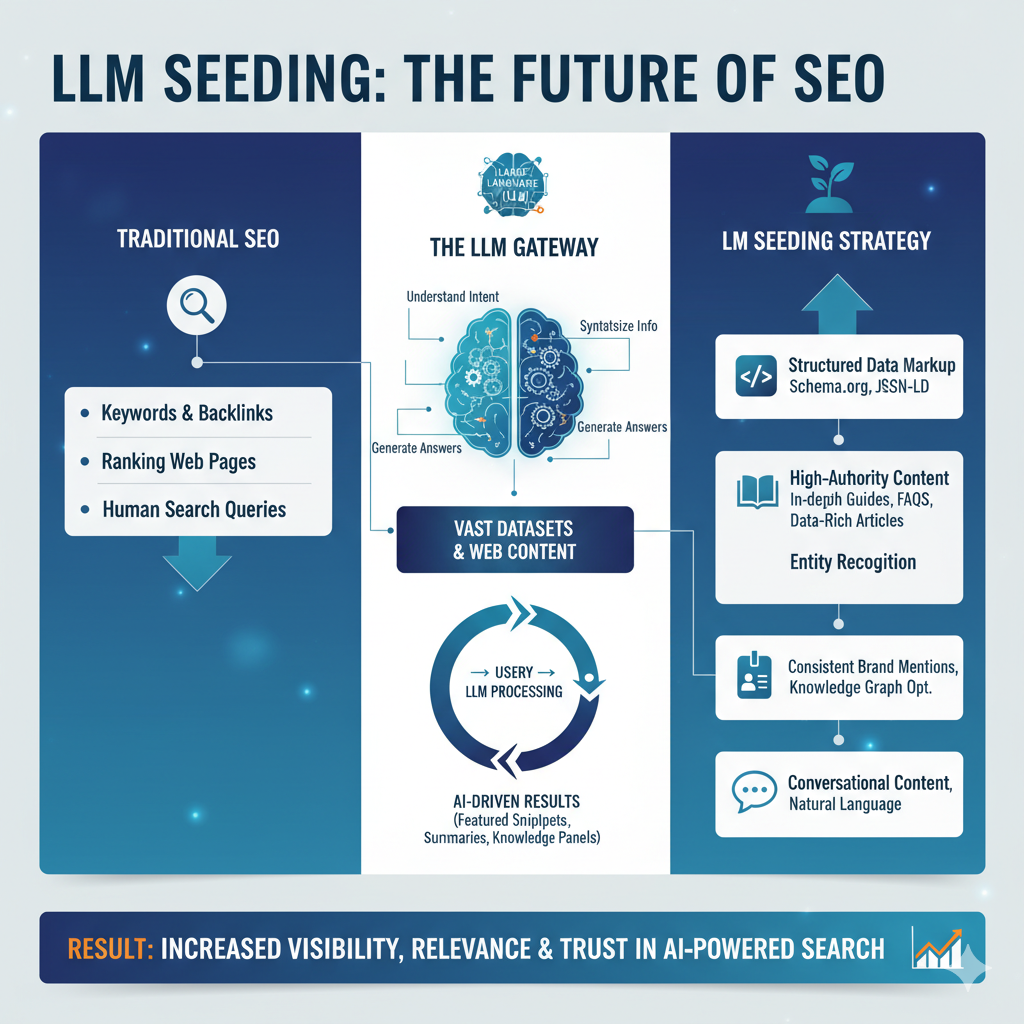
LLM Seeding digs a little deeper than LLM SEO. While LLM SEO is focused on making your current content quotable, LLM Seeding is all about the strategic placement of brand signals, content, and authority indicators across the internet in places where AI models are most likely to learn from and reference, whether it’s during training or retrieval.
Teaching AI Models to Connect Your Brand With Certain Topics
Imagine creating a steady, multi-platform story that AI systems frequently encounter from numerous reliable sources. When an AI model repeatedly sees your brand mentioned in an authoritative manner across industry publications, structured data sources, expert Q&A forums, knowledge bases, and high-authority directories, it starts to connect your brand with trustworthiness on certain topics. That connection is what fuels consistent AI citations over time.
That’s why LLM Seeding isn’t a one-and-done content release — it’s a continuous distribution approach. The aim is to saturate the right signals in the right places with enough volume that the association becomes ingrained in the model’s learned understanding.
- Publish structured, authoritative content on your own domain using clear headers, schema markup, and factual specificity
- Earn mentions on high-trust third-party sources such as industry publications, Wikipedia-adjacent references, and expert roundups
- Build topical clusters that signal deep expertise in a specific subject area rather than scattered general content
- Contribute to Q&A platforms and knowledge bases where AI models frequently draw training and retrieval data
- Use structured data (schema markup) to make your content machine-readable and AI-parseable at the technical level
Each of these tactics reinforces the same signal: this brand knows this topic, is trusted by other authoritative sources, and deserves to be surfaced when relevant questions arise.
Why Trustworthy Sources and Organized Information are Essential for Seeding
Not all web content has the same impact on AI models. High-trust sources — such as reputable publications, well-kept databases, and content written by experts — have a significant influence on both training data and real-time retrieval. A single mention in a credible industry journal will do more for your LLM Seeding strategy than dozens of mentions on low-trust blogs.
Structured data takes this to the next level. Schema markup assists AI platforms in comprehending the context, type, and connections in your content — making it considerably simpler for a language model to accurately extract and cite your data without distorting it.
Comparing LLM Seeding to Traditional Link Building
Traditional link building is all about passing PageRank, which is a signal that Google uses to rank pages in its search results. On the other hand, LLM Seeding is all about building AI trust signals, which is a completely different goal. A backlink from a high-DA site will help your search rankings. However, a mention in an authoritative, well-structured piece of content on that same site will build the brand association that LLMs are looking for. The source might be the same, but the mechanism and the goal are different.
Understanding AI SEO

AI SEO is the most well-known of the three strategies, but it’s often misinterpreted. It’s not about optimizing for AI assistants. It’s about using AI-powered tools to perform traditional SEO tasks more efficiently, intelligently, and on a larger scale. The goal is still to rank well on Google (and Bing). The difference lies in the process, not the end goal.
Marketers who take advantage of AI SEO are using tools such as Semrush’s AI features, Surfer SEO, Clearscope, and ChatGPT to speed up keyword research, content briefs, cluster mapping, and technical audits. The result — a well-optimized page that targets a specific search intent — remains unchanged. However, the journey to reach this result is significantly quicker.
Putting AI SEO to Work: Previously, a content team might have spent three days creating a topical cluster map for a new product category. Now, with the help of AI-assisted research and clustering tools, they can complete the same task in just three hours. The strategic judgment still comes from the human, while the model handles the tedious work.
While this efficiency advantage is real and substantial, it doesn’t address the increasing amount of information discovery that’s happening inside AI chat interfaces. That’s why relying solely on AI SEO is no longer enough for brands that want comprehensive visibility across both traditional and AI-mediated search.
How AI Tools Can Enhance Traditional SEO Rankings
AI SEO can be used at every stage of the content creation process. During the research phase, AI tools like ChatGPT and Perplexity can quickly identify variations in search intent, related questions, and content gaps that might take a human analyst much longer to find. During the optimization phase, tools like Surfer SEO can compare your content with that of top-ranking competitors in real time and provide feedback on keyword density, heading structure, and word count targets. During the audit phase, AI-assisted crawlers can identify technical issues — such as broken internal links, duplicate meta descriptions, and thin content pages — much faster than traditional audits. For more insights, check out this guide to optimizing LLM search strategies.
AI SEO doesn’t alter the basic principles of Google’s ranking algorithm. Core Web Vitals, E-A-T signals, backlink authority, and search intent alignment continue to be the driving forces behind rankings. AI tools simply make it easier to meet these requirements, they don’t replace them.
How AI SEO Can Improve Your Workflow: Research, Drafting, Clustering, and Audits
AI SEO can be used in any part of your workflow where speed and scale are the main challenges. Keyword clustering that used to take a specialist a whole week can now be done in just an afternoon. First-draft content outlines that align with search intent can be created in minutes and then refined by human editors. Technical SEO audits can be done more often, catching regressions before they become more serious. For teams with limited resources, this increased efficiency is a game changer — it frees up strategic bandwidth that was previously used for repetitive analytical tasks.
Comparing LLM SEO, AI SEO, and LLM Seeding
LLM SEO, AI SEO, and LLM Seeding are all related, but they aren’t the same thing. They solve different problems, and it’s a common mistake to use them interchangeably. Here’s a detailed comparison:
Main Objectives of Each Approach
| Category | AI SEO | LLM SEO | LLM SEEDING™ |
|---|---|---|---|
| Primary Purpose | Use AI tools to improve traditional SEO workflows | Optimize content so LLMs can better interpret and retrieve it | Influence AI-generated answers through distributed brand signals |
| Main Goal | Rank higher in Google & Bing more efficiently | Increase visibility inside AI search experiences | Increase recommendation likelihood in AI-generated responses |
| What It Actually Does | Speeds up SEO execution using AI | Structures content for AI readability and retrieval | Expands brand presence across trusted digital ecosystems |
| Focus Area | Workflow automation & optimization | AI-friendly content architecture | External authority and citation engineering |
| Core Strategy | AI-assisted keyword research, clustering, audits, and drafting | Semantic structure, entities, schema, conversational formatting | Publishing structured brand mentions across many trusted sources |
| Powered By | AI tools like ChatGPT, Surfer SEO, Clearscope, Semrush AI | Structured content systems and retrieval optimization | Distributed content networks and entity reinforcement |
| End Goal | Better traditional search rankings | Better AI comprehension | Better AI recommendations |
| Main Platforms | Google, Bing | ChatGPT, Gemini, Claude, Perplexity, Google AI Overviews | ChatGPT, Gemini, Claude, Perplexity, AI retrieval systems |
| Relationship to Traditional SEO | Direct extension of traditional SEO | Evolves SEO for AI interfaces | Goes beyond SEO into AI influence systems |
| Website Dependency | Very high | High | Medium |
| External Platform Dependency | Low | Medium | Very high |
| Main Optimization Target | Search engines | LLM retrieval systems | AI trust and citation signals |
| Typical Activities | Keyword clustering, content briefs, audits, optimization scoring | Structured FAQs, schema, semantic organization, entity clarity | Multi-platform publishing, authority stacking, entity amplification |
| Human Role | Strategic oversight while AI speeds execution | Strategic content structuring | Strategic narrative and authority positioning |
| AI’s Role | Automates repetitive SEO tasks | Consumes and interprets optimized content | Learns from distributed mentions and references |
| Biggest Advantage | Massive workflow efficiency | Better AI discoverability | Higher probability of AI-generated mentions |
| Biggest Limitation | Still dependent on traditional ranking systems | Often limited to owned content | Requires broad distribution and authority building |
| Best For | Teams wanting faster SEO production | Brands adapting to AI search | Brands wanting dominance in AI-generated recommendations |
| Example Outcome | Faster rankings growth | Better inclusion in AI summaries | AI assistants actively recommending your brand |
What Each Approach Aims to Optimize
AI SEO aims to optimize for the signals that Google’s algorithm favors: keyword relevance, topical authority, technical health, backlink equity, and E-E-A-T. Every optimization choice is made with the goal of achieving a higher ranking on a search results page where a human will decide to click — or not. For more insights, you can explore these generative engine optimization tips.
LLM SEO is designed to make your content easily readable and citable by AI. It does this by focusing on factual density, clear structure, direct answers to specific questions, and content that is formatted in such a way that language models can accurately extract and reproduce it without distorting the original meaning. The success of LLM SEO is not measured by a ranking position, but by whether your content appears in the answer itself.
LLM Seeding is designed to optimize brand association at the model level. It is the broadest and longest-term strategy of the three, focusing on distributing consistent, authoritative brand signals across the sources that AI models rely on the most — both during initial training and during real-time retrieval. It’s less about any single piece of content and more about the cumulative pattern of trusted mentions across the web.
What You Can Normally Expect From Each
Companies that put their money into AI SEO usually experience quicker content creation cycles, more uniform on-page optimization scores, and superior keyword coverage — all of which lead to better organic search rankings as time goes on. The outcomes can be gauged in ways you’re used to: traffic, rankings, impressions.
LLM SEO and LLM Seeding have a unique result. Brands that implement these strategies effectively begin to appear regularly when users ask AI assistants questions in their category. They are mentioned in recommendations, cited in comparisons, and referenced in summaries — even if they don’t necessarily see a corresponding increase in traffic. The value is tangible, but it is reflected in brand awareness, share of voice, and ultimately conversion behavior, rather than in a Google Analytics dashboard.
How to Choose the Right Strategy for Your Business
If you’re looking to increase your organic traffic from Google, you should focus on AI SEO. If your business falls into a category where AI assistants are frequently suggesting products or services to users — such as software, financial services, health, travel, or B2B tools — then you should give serious consideration to LLM SEO and LLM Seeding. If you’re looking to build a lasting brand in an AI-first information environment, you’ll need to use all three strategies. This isn’t a suggestion — it’s a requirement.
Combining the Three Approaches
The best visibility strategy in 2026 doesn’t just pick one of these methods — it combines and synchronizes them. Each approach focuses on a unique aspect of the information ecosystem, and together they provide all-encompassing coverage across both conventional search and AI-guided discovery.
Begin With AI SEO to Improve Speed and Efficiency
AI SEO makes sense as the first step because it enhances everything else. When your team utilizes AI tools to expedite research, effectively group topics, and audit content on a larger scale, you create the strategic bandwidth required to properly implement LLM SEO and LLM Seeding. Attempting to manually operate all three strategies without the aid of AI workflow can lead to bandwidth issues that result in all three strategies underperforming.
Begin by utilizing AI SEO tools to establish your topical authority in Google. A robust traditional SEO foundation — including comprehensive topic coverage, clean site architecture, and solid E-E-A-T signals — also serves as a good infrastructure for LLM citability. Most marketers don’t realize just how much these two strategies have in common.
Implement LLM Seeding to Establish Your Brand’s Presence Online
With a strong content foundation in place, you can use LLM Seeding to extend your brand’s reach into the platforms that AI models deem most reliable. This is a continuous, distribution-focused strategy, not a single content release. The objective is to maintain a powerful presence across a sufficient number of high-trust points of contact so that AI models form lasting links between your brand and your main subjects.
Choose quality over quantity. A well-positioned mention in a respected industry publication, a well-organized entry in a relevant knowledge base, or a cited contribution to a high-authority Q&A resource will do more for your LLM Seeding strategy than publishing fifty low-quality articles on your own blog. The signal must come from sources that the model already trusts.
Before you start building, take a good look at where you are now. Use tools like ChatGPT, Gemini, Claude, and Perplexity to search for your brand name and key topics. Pay attention to the results you get — and the ones you don’t. The holes you discover in that audit will tell you where to focus your LLM Seeding efforts.
- Target established industry publications for guest contributions and expert quotes that generate high-trust citations
- Build or update structured knowledge base entries relevant to your brand’s core topics
- Contribute expert answers on high-authority Q&A platforms that AI retrieval systems frequently reference
- Implement schema markup across your site to make content machine-readable and AI-parseable
- Develop topical cluster content that demonstrates deep expertise in a focused subject area rather than broad, shallow coverage
- Monitor AI mention frequency across major assistants on a regular cadence to track progress and identify new gaps
Apply LLM SEO to Make Your Content Easy for Answer Engines to Cite
The structural decisions you make when writing content determine whether AI assistants can accurately extract and cite it. Lead with direct answers. Use specific headers that match the way questions are actually asked. Break complex topics into clearly labeled sections with factual, dense prose rather than vague generalizations. AI models favor content that is self-contained — meaning a single section can be lifted and understood without needing the surrounding context to make sense of it. For more insights on optimizing your content, explore our LLM search strategy techniques guide.
For those who are serious about LLM SEO, schema markup is a must. FAQ schema, Article schema, and HowTo schema all aid AI systems in understanding the type of content they are reading and how to classify it. When you combine structured markup with content that fully answers the question — not just a teaser that requires a click to see the full answer — you significantly increase your chances of being quoted in a generated response instead of being ignored.
Is LLM Seeding a Substitute for Traditional SEO?
Not at all — and the phrasing of that question uncovers a common misunderstanding. LLM Seeding and traditional SEO aren’t vying for the same budget or addressing the same issue. Traditional SEO generates organic traffic from search engines. LLM Seeding creates brand awareness within AI-produced responses. The audiences somewhat intersect, but the methods are completely distinct. The brands that are seeing the most success in 2026 are operating both simultaneously, using their SEO groundwork to establish subject matter expertise and their LLM Seeding approach to expand that expertise into AI-assisted information channels. Giving up SEO for LLM Seeding would be akin to shutting down your website because you started a social media account — the reasoning doesn’t add up.
A Comprehensive Visibility Strategy Incorporates All Three
Search visibility was once a one-dimensional term. Today, it means appearing across multiple information channels — Google SERPs, AI-generated answers, and the expanding ecosystem of AI-assisted research tools that professionals use every day. The brands that will dominate their industries over the next five years are those currently building authority across all three layers: utilizing AI SEO to create superior traditional content more quickly, employing LLM Seeding to establish enduring brand signals in the sources AI models trust, and applying LLM SEO principles to make each piece of content quotable by answer engines. The gap between brands implementing this integrated strategy and those still running SEO-only playbooks is growing every quarter. The time to close that gap is now.
Common Questions
Those who are new to the three strategies discussed in this guide often have similar questions. Here are the most frequently asked questions and their answers. For a deeper dive into these strategies, check out our complete guide to AI visibility marketing.
Knowing the differences between these strategies and when to use each one is the basic building block of any successful AI visibility strategy. The questions below cover both the strategic differences and the practical steps most teams need before they can start.
What separates LLM SEO from AI SEO?
LLM SEO focuses on having your brand mentioned in AI-generated responses from systems like ChatGPT, Gemini, and Claude. AI SEO, on the other hand, involves using AI-driven tools to enhance your standard search rankings on Google and Bing. The AI model itself is the target audience for LLM SEO — you’re optimizing for how it assesses and presents content. The target for AI SEO remains Google’s algorithm — you’re simply using AI tools to carry out the optimization work more quickly and efficiently. For a comprehensive understanding, check out this complete guide to AI visibility marketing.
Can LLM seeding substitute traditional SEO?
No—LLM SEEDING™ doesn’t fully replace traditional SEO, and treating it as a substitute would be risky for most businesses.
They solve different layers of visibility:
Traditional SEO is still responsible for:
- Getting your site indexed and crawled properly
- Ranking in Google and other search engines
- Driving direct search traffic through keywords, backlinks, and technical optimization
LLM SEEDING™ focuses on something different:
- How AI systems interpret your brand across the web
- Whether your brand is seen as an “entity” worth trusting
- Whether you get cited or recommended in AI-generated answers
In practice, they stack on top of each other, not replace each other.
If SEO is the foundation that makes you discoverable in search engines, LLM SEEDING™ is the layer that influences how AI systems summarize, trust, and recommend you.
A brand ignoring SEO still struggles with visibility in search.
A brand ignoring LLM SEEDING™ may show up in search but get excluded from AI recommendations.
The strongest strategy is both:
SEO for access
LLM SEEDING™ for AI influence
Which AI models should I focus on for LLM SEO optimization?
Begin with the platforms your target audience frequents. For B2C brands, ChatGPT has the most users and should be your first focus for LLM SEO testing and optimization. Perplexity matters a lot because it is directly search-augmented and it cites sources, making it easier to track when your content is referenced. Gemini is increasingly important for audiences that are deeply embedded in Google’s ecosystem — Gmail, Docs, and Search users who encounter Gemini-generated summaries.
Anthropic’s model has strong adoption in technology, legal, and research-heavy sectors, which makes Claude a B2B and professional audience’s center of attention. Instead of trying to optimize for all four at once, it’s better to audit which platforms your specific audience actually uses, establish your baseline mention frequency on each, and prioritize the ones with the largest gap between your current visibility and your competitors’ presence.
What is the timeline for seeing results from LLM seeding?
For AI models that mainly use training data — updated in cycles — it can take a few months for new seeded content to start affecting how the model reacts. For retrieval-augmented systems like Perplexity and ChatGPT with Browse enabled, high-authority content can start influencing citations within a few weeks of publication. A realistic timeline is three to six months before consistent brand mention improvements can be measured across the major AI platforms, with compounding returns as the volume of seeded signals increases over time.
Is LLM seeding only for large brands, or can small businesses benefit as well?
LLM Seeding is not just for large brands; small businesses can definitely benefit from it. In fact, in some ways, they have a structural advantage. In niche or local categories, the number of brands vying for AI mentions is far smaller than in broad consumer categories. A local law firm, a specialized B2B software tool, or a regional service provider can achieve consistent AI mentions in its specific niche with significantly less investment than a national brand needs to compete in a crowded category.
For small businesses, the main strategy is to concentrate on a few key areas. Instead of trying to create AI visibility for every conceivable topic, limit your LLM Seeding efforts to the two or three specific questions that your ideal customers are most likely to ask AI assistants. Construct authoritative, structured content around those exact questions, earn mentions in the most credible sources relevant to your niche, and let the specificity of your focus do the heavy lifting that budget and scale would do for a larger competitor.
What kind of content is most likely to be cited in AI-generated responses?
The content that is most likely to be cited by an LLM has several common characteristics: it answers questions directly and thoroughly, it uses specific data points instead of vague statements, it is organized with clear headers that match the way questions are typically asked, and it is dense with facts so that a language model can extract a meaningful answer without misrepresenting the original content. Long-form, authoritative guides — especially those that compare options, explain processes step by step, or define industry concepts with precision — are cited by AI more frequently than thin or promotional content. Content structured as an FAQ is particularly effective because it mirrors the question-answer format that AI assistants use when generating responses.
How can I tell if AI assistants are mentioning my brand?
The easiest place to begin is with manual prompt testing. Launch ChatGPT, Gemini, Claude, and Perplexity and pose the questions your prospective customers are most likely to ask — category questions, comparison questions, requests for recommendations, and problem-solution queries that are relevant to your field. Keep track of whether your brand is mentioned, how it’s described, and which competitors are mentioned when you aren’t. Do this every month to monitor changes over time.
There are now dedicated AI monitoring tools that can automate this process on a large scale. These platforms are designed to track brand mentions across AI-generated outputs and can show citation frequency, sentiment, and competitive share of voice without the need for manual queries. These tools are still in the process of maturing, but for brands that are serious about AI visibility, they are becoming as essential as rank trackers were in the early days of SEO.