Article-at-a-Glance: Key Takeaways
- AI visibility marketing strategies focus on getting your brand cited inside ChatGPT, Perplexity, and Google AI Overviews answers, not just ranked on a results page.
- 48% of tracked Google queries now trigger an AI Overview, and that number jumped 58% year-over-year as of February 2026.
- When AI Overviews appear, organic click-through rates drop by 61% on average, which means brands absent from AI answers are losing traffic they used to count on.
- Each AI platform, from ChatGPT to Gemini to Copilot, pulls citations differently, so a one-size-fits-all SEO strategy will not get you cited everywhere.
- Free AI Visibility checker reports provided by LLM SEEDING™ Network ,A free check that shows whether ChatGPT, Claud, Gemini , Perplexity, and Google AI name your business when somebody asks for a recommendation, or hand the answer to somebody else. It takes about a minute.
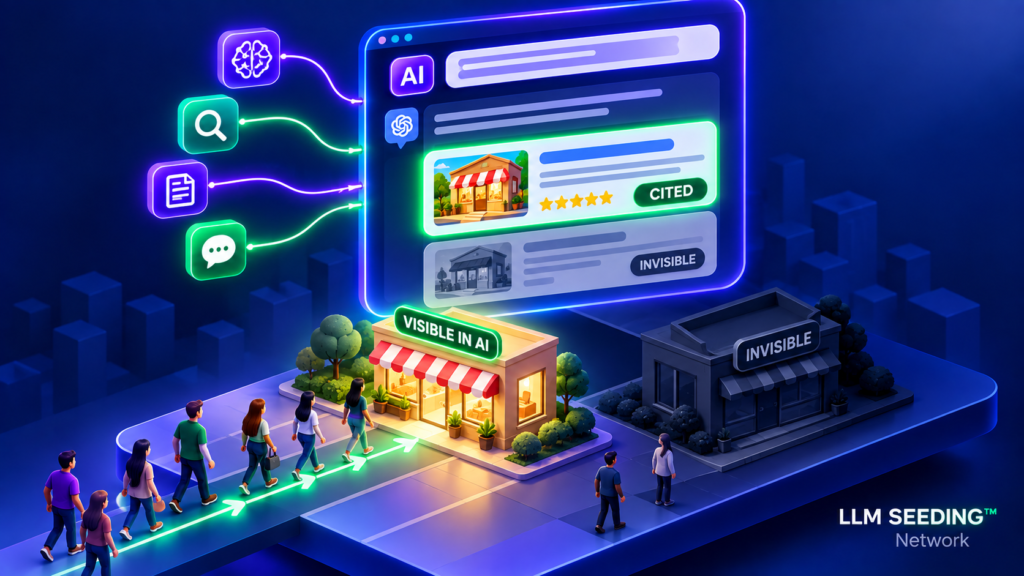
Your Brand Is Either Cited or Invisible in AI Answers
Type a question into ChatGPT or Google’s AI Overview right now and watch what happens. You get one synthesized answer, built from a handful of sources the AI decided were worth citing. Your competitor might be one of them. You might not be. There’s no page two to flip to, no spot #7 to climb toward. You’re either in the answer or you’re not.
That shift is rewriting how marketers think about reach. Ranking in position 3 on Google used to be a fine outcome. Getting summarized and cited by an AI engine that 910 million weekly ChatGPT users or 2 billion monthly Google AI Overview users rely on is a different game entirely, and most brands haven’t adjusted their strategy to play it. The free AI Visibility report from LLM SEEDING™ Network was built for exactly this problem, because monitoring “did the AI mention us” requires different tools than monitoring keyword rank: it checks whether ChatGPT, Claude, Gemini, Perplexity, and Google AI name your business when someone asks for a recommendation, or hand the answer to somebody else.
What Is AI Visibility
AI visibility is the practice of monitoring and improving how often your brand gets cited, named, or referenced inside AI-generated answers, across tools like ChatGPT, Perplexity, Claude, Gemini, Copilot, and Google’s AI Overviews. It’s the newer, adjacent discipline to SEO, built around a completely different mechanic: instead of competing for rank position, you’re competing to be one of the sources an AI model decides to pull from and cite when generating its answer.
This matters because the volume behind these platforms is no longer niche. Perplexity alone has reached 45 million monthly active users, and OpenAI has crossed $25 billion in annualized revenue, numbers that reflect how much everyday search behavior has already migrated toward AI-generated answers instead of traditional blue links.
How AI Visibility Differs From Traditional SEO Rankings
Traditional SEO is a ranking model. You’re fighting for a numbered position, 1 through 10, and every position above yours still sends some traffic your way even if it’s less than the top spot. AI visibility doesn’t work that way. There’s no position 4 in a ChatGPT answer. The model either cites your brand, quotes your content, or names your product, or it doesn’t mention you at all.
This is a binary outcome, not a spectrum. A brand can rank #1 on Google for a topic and still never get mentioned when someone asks an AI assistant the same question, because the AI is pulling from a different set of signals: content structure, freshness, factual density, and how easily its answer can be extracted and summarized.
The Citation Model: Cited or Not Cited, No Middle Ground
Because there’s no middle ground, marketers need to think in terms of coverage across question types rather than single keyword targets. A brand might get cited when someone asks a broad problem-based question but completely miss out when someone asks a comparison question further down the buyer journey. Tracking this requires breaking your content strategy into the actual questions your buyers ask AI at each stage, from early problem-awareness questions through to branded comparison questions where they’re choosing between named providers.
Which AI Platforms Matter Most Right Now
Six platforms currently drive the bulk of AI-generated answer traffic that matters for marketers: ChatGPT, Perplexity, Google AI Overviews, Claude, Gemini, and Microsoft Copilot. Each one sources and displays citations differently, which means a brand optimizing only for one platform is leaving visibility on the table across the other five. We’ll break down exactly how each platform selects and displays sources later in this guide.
Why AI Visibility Matters in 2026
The numbers behind this shift aren’t subtle. Search behavior has moved fast, and the brands still treating AI visibility as optional are watching their organic click-through rates erode in real time.
48% of Google Queries Now Trigger AI Overviews
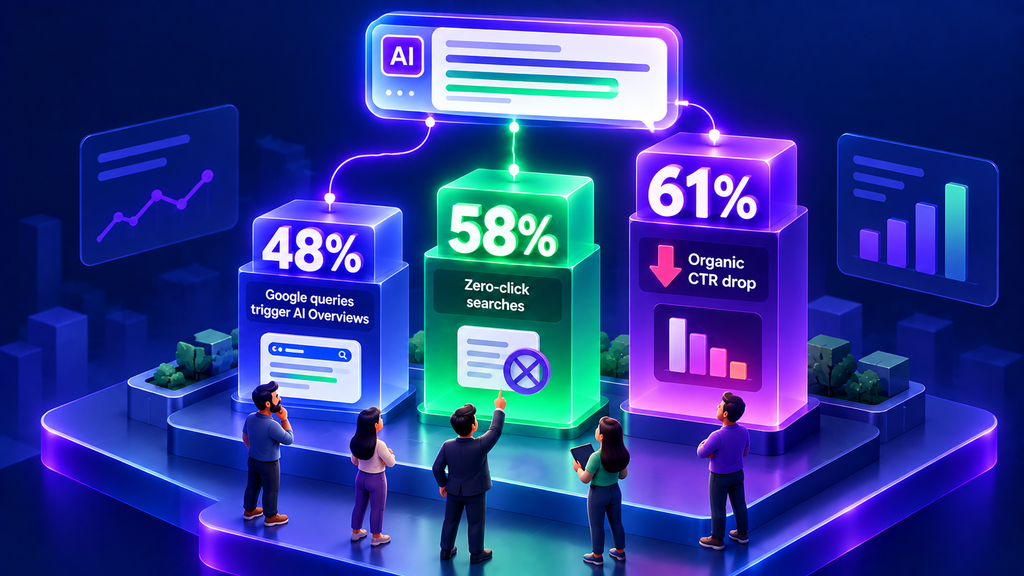
As of February 2026, 48% of tracked queries trigger an AI Overview, a 58% year-over-year increase in how often these AI-generated summaries appear above traditional search results. For question-based queries specifically, that trigger rate climbs to 57.9%. If your content strategy still assumes most searchers scroll past a summary box to click your link, that assumption is failing more than half the time.
Zero-Click Search Has Reached 58% Overall, 93% in AI Mode
Zero-click search, meaning the user gets their answer without clicking any result, now applies to 58% of all Google searches. When users specifically engage with Google’s AI Mode, that zero-click rate jumps to 93%. This tells you something specific about how people are consuming information now:
- They’re getting complete answers directly in the search interface, without needing to visit a website.
- Traditional metrics like organic sessions and pageviews are undercounting how many people actually encountered your brand’s information.
- Being cited by name inside the AI answer, even without a click, still builds brand recognition and trust that a missed citation never gets.
- Marketers who only track click-through traffic are missing a growing share of their actual reach.
This is why AI visibility tracking has become its own discipline. A brand can be doing real work, informing real buyers, and getting zero credit in a traditional analytics dashboard.
Organic Click-Through Rates Drop 61% When AI Overviews Appear
When an AI Overview appears above traditional search results, organic click-through rates for the pages ranking below it drop by 61% on average. That’s not a marginal dip. It means the traffic a page used to earn from ranking well is being intercepted by the AI summary sitting above it, whether or not that summary cites the page at all.
The flip side matters just as much: brands that do appear as a cited source inside an AI Overview see a 35% increase in click-through rates compared to brands that go uncited. Being cited doesn’t just protect you from the traffic drop, it can actively outperform old-school ranking positions.
Search Volume Is Projected to Decline 25% by 2026, 50% by 2028
Gartner has projected that traditional search volume will decline 25% by 2026, with organic search traffic potentially dropping more than 50% by 2028. Combine that with the fact that AI bot traffic already accounts for 4.2% of all global web traffic, and the direction is clear: the queries people used to type into a search box are increasingly being asked directly to an AI assistant instead.
How AI Engines Decide What to Cite
Getting cited isn’t random, and it isn’t just a rehash of old SEO tactics either. AI engines weigh a specific combination of signals when deciding which sources to pull into their generated answers.
Why AI Can Only Repeat What Already Exists Online
AI models don’t invent facts about your brand from nothing. They summarize, synthesize, and cite what’s already published and indexed. If your product’s differentiators, pricing logic, or use cases aren’t clearly written somewhere the model can access, it has nothing to pull from when a relevant question comes up. This is why content gaps matter so much more now: a question your buyers ask that your site never directly answers is a citation opportunity handed to whichever competitor did answer it.
Domain Authority, Backlinks, and Trust Signals
AI engines prioritize content from sources with established domain authority and reputation, including .gov and .edu domains along with well-known publications. Content backed by specific statistics, data points, and cited research gets referenced more often than vague, unsupported claims. Authorship also plays a role: content with clear author bios and credentials receives a trust boost, particularly for topics that fall under “your money or your life” categories like health, finance, and safety.
Why 85% of News Sites Are Blocking AI Bots
Here’s a wrinkle most marketers haven’t caught onto yet. 85% of the top 1,000 news websites now block at least one major AI crawler, and 82% specifically block GPTBot. That’s a massive contraction of the pool of sources AI engines can actually access and cite.
This creates an unusual opportunity. With so much traditional media content walled off from AI crawlers, brands and publishers that allow AI bots to access their content are competing for citation slots against a much smaller field than they’d face in traditional search rankings. Choosing to stay crawlable isn’t a passive decision anymore, it’s a visibility strategy.
The Link Between Google Page-One Rankings and AI Citations
There’s a strong correlation between ranking on page one of Google and getting cited in AI-generated answers. This doesn’t mean traditional SEO is obsolete, it means the two disciplines are increasingly intertwined. Content that earns strong organic rankings through solid keyword targeting, backlinks, and technical SEO is also more likely to get pulled into AI Overviews and chatbot answers, because the underlying trust and authority signals overlap heavily between the two systems.
6 Citation Patterns You Need to Know by Platform
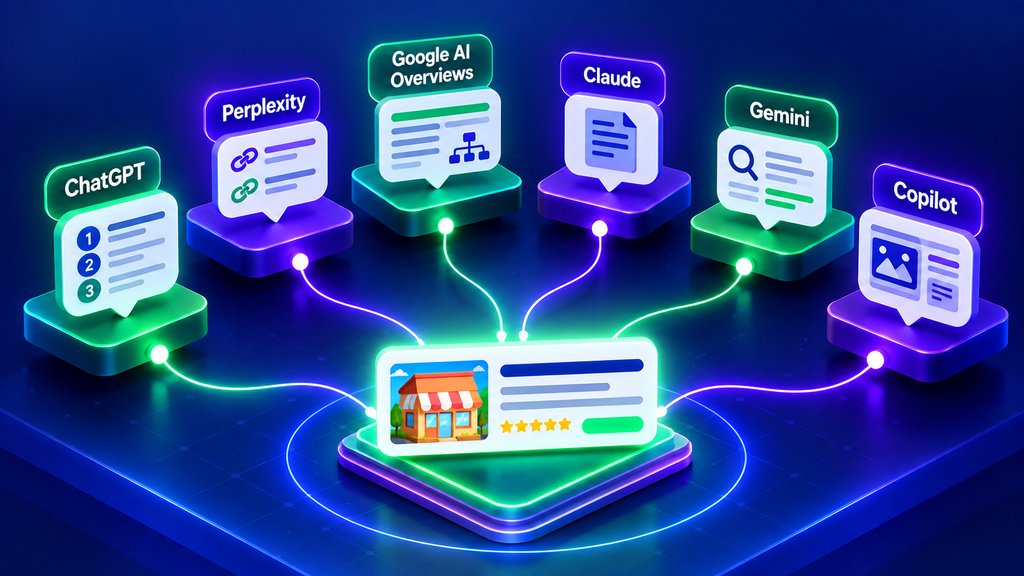
Each AI platform has developed its own citation behavior, shaped by what data sources it has access to and how its underlying model was built. Understanding these differences is the difference between a content strategy that gets cited everywhere and one that only works on one platform.
| Platform | Citation Style | What It Favors |
|---|---|---|
| ChatGPT | Inline numbered references | Encyclopedia-style, comprehensive, high domain authority |
| Perplexity | Direct source links with snippets | Conversational, practical, fresh, community-driven |
| Google AI Overviews | Integrate links directly into synthesized answers, | Structured Data and Featured Snippet Signals |
| Claude | Pulls referenced context from web search results | Clear, Well-Structured Explanations From Web Search Context |
| Gemini | Blends its citations with Google Search results directly | Google-Indexed Content With Traditional SEO Signals |
| Copilot | Sources its citations from Bing | Bing-Optimized Content and News Sources |
- ChatGPT: Encyclopedia-Style Coverage With Inline Numbered Citations
ChatGPT displays citations as inline, numbered references, similar to footnotes in an academic paper. It favors encyclopedia-style, comprehensive coverage of a topic, weighing domain authority and factual density heavily in its selection. This means thin, single-angle content tends to underperform here, while long-form, thorough resources that cover a topic from multiple angles tend to get pulled more consistently. For more on how AI search optimization compares to traditional SEO, check out this guide.
- Perplexity: Conversational Content With Fresh, Practical Examples
Perplexity uses direct source links paired with content snippets, and it clearly favors conversational, practical content built around real examples rather than abstract explanations. Freshness matters a lot here, along with community insights, meaning forum discussions, recent case studies, and up-to-date data tend to outperform older, more static reference content.
If your brand publishes case studies, real customer numbers, or recent industry commentary, Perplexity is often the platform most likely to surface and cite that kind of content quickly, sometimes within days of publication rather than months.
- Google AI Overviews: Structured Data and Featured Snippet Signals
Google AI Overviews integrate links directly into synthesized answers, and it heavily favors content that’s already structured for featured snippets, meaning clear headers, direct answers near the top of a page, and schema markup. E-E-A-T signals (experience, expertise, authoritativeness, and trustworthiness) carry real weight in what gets selected here, which lines up closely with what’s already worked for traditional SEO featured snippet optimization.
- Claude: Clear, Well-Structured Explanations From Web Search Context
Claude pulls referenced context from web search results and tends to favor clear, well-structured explanations over dense, jargon-heavy writing. Source quality and content clarity drive its selection more than raw keyword matching, which means a page that explains a concept simply, with logical section breaks, often outperforms a technically accurate but poorly organized competitor page.
This makes Claude one of the more forgiving platforms for smaller brands. You don’t need a decade of domain authority to get cited here, you need content that answers the question clearly and doesn’t bury the point under unnecessary complexity.
- Gemini: Google-Indexed Content With Traditional SEO Signals
Gemini blends its citations with Google Search results directly, which means it leans heavily on Google-indexed, high-ranking content. Traditional SEO signals, backlinks, keyword relevance, and content freshness carry real weight here in a way that mirrors classic search engine optimization more than any other AI platform on this list. If your SEO fundamentals are already solid, Gemini visibility often follows naturally.
- Copilot: Bing-Optimized Content and News Sources
Copilot sources its citations from Bing, favoring Bing-optimized content and news sources. Bing ranking signals and timeliness drive what gets pulled into an answer, which means brands that have historically ignored Bing SEO in favor of Google-only optimization are likely underperforming here without realizing it.
Because Copilot is built into Microsoft’s ecosystem, including Windows search and Edge browser defaults, it reaches a meaningful slice of business and enterprise users who may never touch ChatGPT or Perplexity. Ignoring Bing-side optimization means missing that audience entirely.
Real Citation Data: What Brand Performance Actually Looks Like
Numbers make this concrete. One independent audit tracked how often a real brand, got cited across 34 real buyer questions spanning the full journey from early problem-awareness to branded comparison shopping, and the results show exactly how uneven AI citation can be even for a brand actively competing in its space.
Tracking Citation Volume Month Over Month
Citation volume isn’t static, it moves month to month, and tracking it over time reveals real swings in visibility. one client’s citation count moved as follows across an independent index: 139 citations in September 2025, dipping to 137 by March 2026, climbing to 177 in May 2026, dropping to 143 in June, falling further to 120 in July, then rebounding to 191 in August 2026.
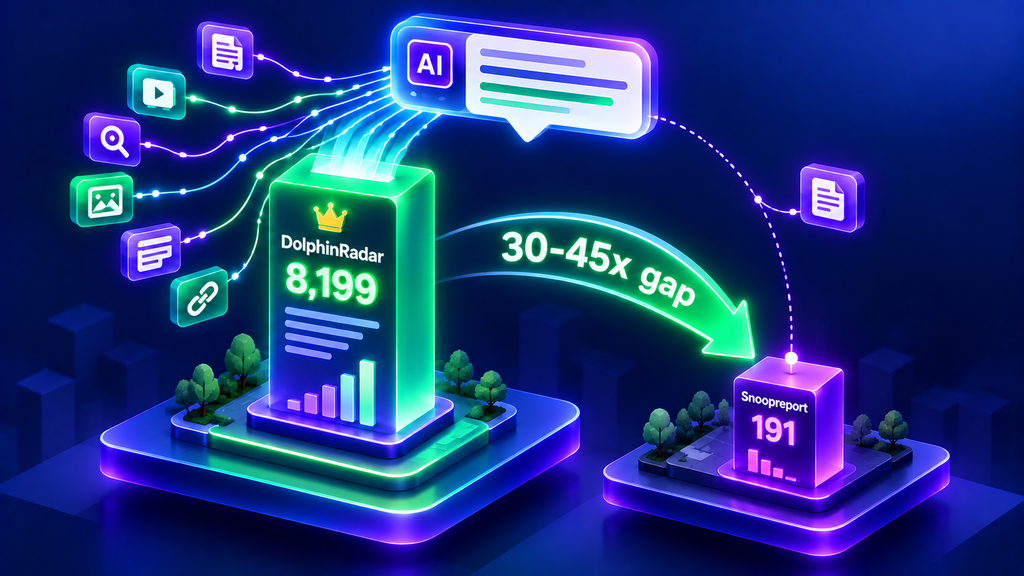
Compare that against a competitor, DolphinRadar, tracked over the same window: 6,171 citations in September 2025, 4,509 in March 2026, 4,625 in May, 5,106 in June, 4,670 in July, and 8,199 in August 2026.
The gap here isn’t subtle. competitor’s citation volume ran roughly 30 to 45 times higher than one client’s across nearly every month tracked. This is the kind of gap that traditional SEO rank tracking would never surface, because it has nothing to do with keyword position and everything to do with which brand the AI models have decided is the more citable authority in this space.
Where Brands Win: Pain Points, Product Questions, and Comparisons
one client’s citation performance varied dramatically depending on where the buyer was in their journey. For early pain-and-problem questions, where buyers know they have an issue but haven’t identified a solution category yet, one client was cited in just 2 out of 14 questions. Once buyers moved to product-and-solution questions, meaning they knew what kind of tool they needed and were comparing options, citation performance jumped to 12 out of 14. When buyers reached the branded comparison stage, already knowing exactly what they needed, one client was cited in all 6 questions tested, and it scored a perfect 6 out of 6 when asked about by name directly. For more insights on why shoppers use both, explore AI tools vs Google Search.
Where Brands Lose: Competitor-Won Questions and Missing Mentions
The flip side of that data matters just as much. Across all 34 questions tested, ChatGPT specifically never named one client by name in a single answer. Seven of the questions were flatly won by competitors, meaning the AI named a rival brand and never mentioned one client at all. And in 8 separate answers, one client got mentioned by name but without a link back to its site as a source, a visibility win that still leaves real traffic on the table.
Closing the Content Gap Nobody Talks About
Most brands assume their existing content library already covers what buyers are asking AI assistants. It usually doesn’t, and the gap is often bigger than marketers expect. To bridge this gap, businesses should explore strategies for improving AI visibility and local SEO to ensure their content meets the evolving needs of AI-driven search queries.
In one client’s case, the site’s content aligned with 29 of the 34 real buyer questions tested, a solid coverage rate on paper. But that remaining 15% represents a specific, identifiable content gap, and closing gaps like this is often the fastest lever available for improving AI citation rates.
Why the Citation Gap Between Competitors Keeps Widening
Citation gaps compound. Once an AI model has repeatedly cited a competitor for a certain type of question, that pattern tends to reinforce itself, since the model’s training and retrieval behavior treats prior citation success as a signal of reliability. The specific buyer questions one client’s content failed to address included:
- Which service shows ongoing engagement patterns beyond basic follower data
- Which platform gives detailed breakdowns of Instagram engagement beyond follower counts
- How can I tell if my teenager is engaging with risky accounts on Instagram
Each of these represents a real, specific question a buyer typed into an AI assistant, and each one is a citation opportunity that went uncontested to whichever competitor had already published a direct answer.
This is exactly how a 30-to-45x citation gap builds over time. It’s rarely one dramatic failure, it’s a series of smaller, specific questions where a brand simply never published the answer, so the AI had nothing of theirs to cite.
Closing this kind of gap requires the same discipline as a traditional content gap analysis, just pointed at AI-specific query patterns instead of keyword volume. Pull the real questions your buyers are asking AI tools, check whether your site directly answers each one, and prioritize publishing against the gaps first. For a comprehensive approach, consider strategies for micro-niche dominance to effectively target your audience.
Mentions Without Links: A Hidden Visibility Problem
Getting named without getting linked is its own category of lost opportunity. In one client’s data, 8 separate AI answers mentioned the brand by name but never linked its site as a source, meaning users heard the brand name but had no direct path to visit and convert.
This pattern likely stems from AI models relying on stored memory rather than live web checks. In fact, 52 of the AI answers tracked in this audit came from stored model memory instead of a live web search, which means the AI recalled the brand name from its training data but didn’t treat the current live site as citation-worthy in that moment.
Why This Is a Publishing Problem, Not a Technical One
None of this comes down to a technical SEO fix. It comes down to publishing volume, freshness, and coverage breadth. A brand that only publishes occasional blog posts on its own domain is giving AI models a thin, static picture to draw from. A brand that publishes consistently across multiple content types and platforms gives AI models far more surface area to pull fresh, linkable citations from.
How to Build AI Visibility Through Multi-Channel Publishing
The fix for thin AI visibility isn’t a single blog post, it’s a distribution strategy built around how differently each AI engine sources its answers.
Since AI models scan far beyond any single brand’s own domain, showing up in front of them means showing up in the places they’re already scanning, news networks, video platforms, podcast directories, and content aggregators that get crawled and indexed constantly.
Why 73% of Searches Now Happen Outside Google
There are 51 billion searches happening daily across platforms, and only 27% of them happen on Google. That means 73% of all search activity is happening across 17 other platforms entirely, everywhere from YouTube to TikTok to Amazon to Bing. A brand that only optimizes for Google rankings is, by definition, ignoring the majority of where search behavior actually lives now.
This matters directly for AI visibility because several AI engines, Copilot most obviously, pull from these non-Google sources. Building visibility only on Google leaves entire platforms of potential AI citation opportunity untouched.
The 8 Content Formats That Feed AI Engines
A single blog post can only get you so far. Real AI visibility strategies spread the same core message across multiple content formats, since each format gets indexed and crawled by different platforms and different AI engines. The eight formats worth publishing consistently are professional news articles, SEO-optimized blog posts, long-form explainer videos, reels and shorts, interview-style podcasts, slideshows and flipbooks, and infographics.
Each format feeds a different part of the AI citation ecosystem. A long-form explainer video published to YouTube gets indexed differently than a blog post, and an infographic pinned to Pinterest gets picked up by entirely different crawlers than a podcast episode distributed to Spotify.
Publishing Across 300+ Platforms for Maximum Reach
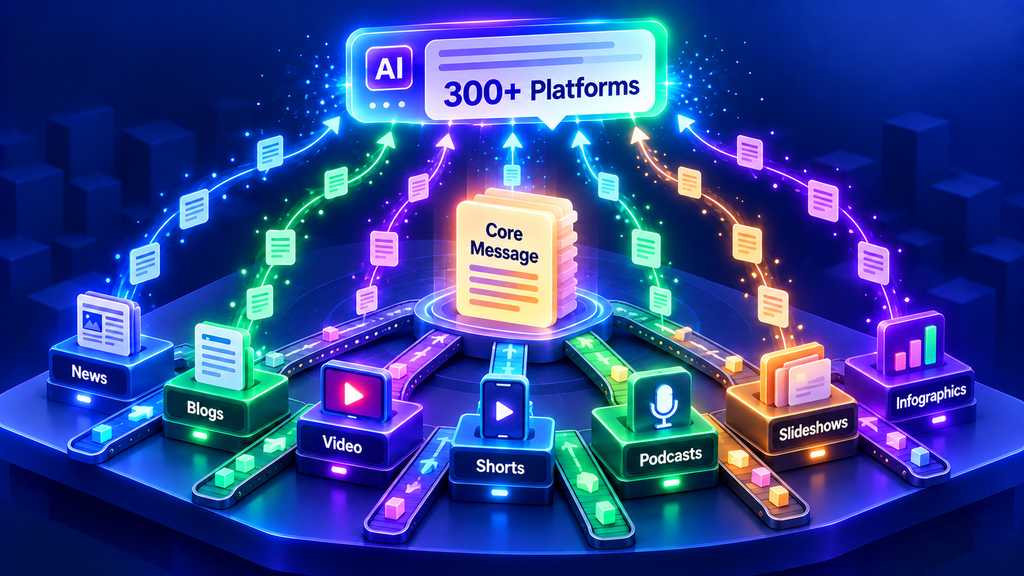
One practical approach involves publishing the same core content across a marketplace of over 1,000 sites, with individual campaigns typically reaching 300 or more platforms at once. This isn’t about spamming the same article everywhere, it’s about matching each content format to the platforms built for it.
| Content Format | Example Platforms |
|---|---|
| Professional news articles | Google News, NewsNetMedia, The Chronicle Journal, NCN, HTV10 |
| SEO-optimized blog posts | Telegra.ph, Flipboard, APSense, DailyMoss, Morning Dispatcher |
| Long-form explainer videos | YouTube, Vimeo, DailyMotion |
| Reels and shorts | YouTube Shorts, TikTok, Instagram, Facebook |
| Interview-style podcasts | Spotify, Apple Podcasts, Amazon Music, Podbean, Mixcloud |
| Slideshows and flipbooks | SlideShare, Box, Dropbox, Anyflip, FlipHTML5 |
| Infographics | Pinterest, Diigo, ImgBB, Plurk, ImageShack |
Spreading a single piece of core research or messaging across all seven of these formats means an AI engine crawling any one of these platform types has a chance to find and cite your brand, rather than depending entirely on whether it happens to crawl your homepage that week.
This is also why brands working with LLM SEEDING™ Network get an edge here, pairing wide-reach publishing with the monthly tracking in our AI visibility report, which shows whether ChatGPT, Claude, Gemini, Perplexity, and Google AI actually name your business, so you can see what’s working rather than just guessing.
Real Business Results From AI Visibility Strategies
The theory behind AI visibility only matters if it produces real revenue, and the documented results from brands that committed to multi-channel organic publishing back up the strategy with hard numbers.
These aren’t marginal wins. Several documented cases show organic, AI-visible content producing returns that paid advertising simply can’t match at the same cost.
How One Medical Device Brand Grew Traffic 20,000% in a Year
One medical device brand increased its traffic by approximately 20,000% within a single year, growing monthly sales from $48,000 to $735,000. Annualized, that’s an $8,300,000 increase in yearly sales growth, driven by organic visibility rather than paid ad spend.
How a Single Article Generated $6,000+ ROI
Not every result requires a full year-long campaign. A high-ticket sales company achieved more than $6,000 in ROI from a single published article, showing that even individual, well-targeted pieces of content can produce outsized returns when they land in front of the right buyer at the right moment in their research.
Other documented results include a toys and educational shop generating over $100,000 monthly from organic traffic alone, and another business producing $1.6 million in sales over 12 months with zero ad spend, relying entirely on organic content reach.
Long-Term Organic Traffic That Keeps Paying Off for Years
The clearest advantage organic AI visibility holds over paid advertising is durability. Paid ads typically return 1 to 3x on spend, and that traffic stops the moment the ad budget stops. Multi-platform organic content, by comparison, typically returns 5 to 50x over the long term, and it keeps generating traffic for months or years after publication.
One business saved $7,038 per month on AdWords spend simply by replacing that budget with organic traffic generation. And brands that run paid ads alongside strong organic visibility see their ad conversions improve too, since customers who see a brand consistently across organic channels convert 3 times more often when they later see that same brand’s paid ad.
How to Measure Your AI Visibility
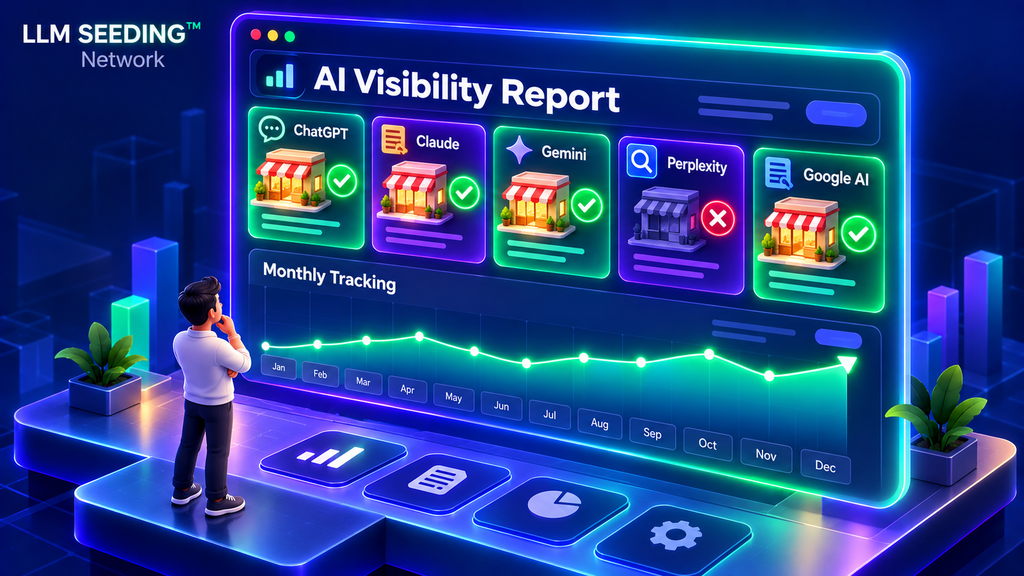
None of this works without measurement. Tracking AI visibility means monitoring citation frequency across platforms, understanding how your brand’s sentiment shows up when it is mentioned, and identifying exactly which buyer questions your content still fails to answer.
Citation Frequency and Share of Voice
Citation frequency is the simplest place to start. This just means counting how often your brand name, product, or domain shows up across a fixed set of AI-generated answers over a set period, whether that’s weekly or monthly. one client’s tracked data shows exactly why this matters: watching citation counts move from 139 to 177 to 120 to 191 across different months reveals real momentum shifts that a single snapshot check would completely miss.
Share of voice takes this a step further by comparing your citation count against a direct competitor’s over the same period. When DolphinRadar pulled in 8,199 citations in August 2026 against one client’s 191, that comparison tells a far more useful story than either number alone. A brand with 200 citations might feel fine until it sees a competitor sitting at 8,000.
Building this kind of tracking doesn’t require guesswork. Set a recurring schedule, monthly is usually enough, and log citation counts against the same competitor set every time so trends actually mean something. Watch specifically for:
- Sudden drops that might signal a content update the AI model no longer trusts or a competitor’s new publish that displaced you
- Sudden spikes that might correlate with a specific piece of content you published, worth replicating
- Seasonal patterns tied to when your industry’s buyers are actively researching
Sentiment Analysis and Query Coverage
Getting cited isn’t automatically a win if the AI describes your brand poorly. Sentiment tracking looks at how AI models characterize your brand across every answer where you’re named, not just whether you’re named at all. In one client’s case, across 37 answers that named the brand, sentiment broke down as 18 positive, 16 neutral, and 3 negative, a mostly favorable but not spotless picture.
Query coverage works alongside sentiment tracking by mapping how many of the real questions your buyers ask AI assistants your existing content actually answers. one client’s content aligned with 29 of 34 tested buyer questions, an 85% coverage rate that still left specific, identifiable gaps unaddressed. Running this kind of coverage audit regularly means catching new buyer questions before a competitor answers them first.
Tools That Track AI Citations Monthly
Several platforms have built dedicated AI visibility tracking into their existing toolsets. LLM SEEDING™ Network offers an AI visibility report that checks ChatGPT, Claude, Gemini, Perplexity, and Google AI to show whether each one names your business when someone asks for a recommendation, with monthly tracking so you can see how your visibility changes over time and act on the gaps. Semrush has added AI Overviews tracking within its Positions report, giving marketers already using Semrush for rank tracking a natural extension into AI citation data. Ahrefs Brand Radar monitors more than 286 million prompts across AI platforms, offering scale that few competing tools match.
7 Steps to Optimize Your Content for AI Citations
Measurement only matters if it leads to action. Once you know where your citation gaps are, the actual content changes needed to close them follow a fairly consistent playbook, regardless of industry.
These seven steps aren’t sequential requirements, they’re the core habits worth building into every piece of content your team publishes going forward. For a deeper understanding of these strategies, explore our guide on LLM seeding vs AI search visibility.
1.Answer the Query in the First 40-60 Words
Every page targeting AI visibility should deliver a direct, concise answer to its core question within the first 40 to 60 words. AI models scanning a page for extractable answers favor content that states its point immediately rather than building up to it through several paragraphs of background.
This doesn’t mean sacrificing depth further down the page. It means front-loading the direct answer, then using the rest of the page to add nuance, examples, and supporting detail for readers who want more.
2.Include a Statistic Every 150-200 Words
Content with specific statistics, data points, and cited research gets referenced by AI engines far more often than vague, unsupported claims. Building in a specific number or data point roughly every 150 to 200 words keeps a page dense with the kind of factual material AI models are actively looking to extract and cite.
This also happens to make content more useful and credible for human readers, which is exactly the kind of dual benefit worth prioritizing. A page full of general statements about “improved efficiency” or “significant growth” gives an AI model nothing concrete to pull, while a page citing exact percentages, dollar figures, or timeframes gives it plenty.
Pair each statistic with its original source wherever possible. This isn’t just good practice, it directly feeds the next step.
3. Link Every Data Point to Its Source
Every statistic or data point included in your content should link back to its primary source. AI engines weigh sourced, verifiable claims more heavily than unsourced assertions, and this same practice builds trust with human readers checking your work.
4. Structure Content With Headings, Lists, and Tables
Content organized with clear headings, bullet lists, tables, and FAQ sections is easier for AI engines to parse and extract citations from. Dense walls of unbroken text force an AI model to do more work identifying discrete, citable facts, while clearly labeled sections make the extraction process straightforward. For more insights on improving your content strategy, explore content production vs. link building to see what’s worth your budget.
This is precisely why comparison tables, step-by-step numbered lists, and clearly labeled FAQ sections tend to outperform narrative-only content in AI citation rates. Structure isn’t just a readability choice anymore, it’s a technical requirement for AI discoverability.
5. Use Question-Format Headings That Match How People Ask AI
Headings written as direct questions, matching the actual phrasing people type into AI assistants, make it easier for models to match your content to a specific query. A heading like “How Do I Know If My Brand Is Being Cited by AI?” maps far more directly to a real user prompt than a vague heading like “Measurement Considerations.”
6. Update Content Regularly to Signal Freshness
AI platforms favor recently published or updated content, particularly Perplexity and Gemini, both of which weigh freshness heavily in their citation decisions. Revisiting older content to update statistics, examples, and dates on a regular schedule signals to these models that the page remains current and reliable. For more insights, explore the importance of website optimization for generative AI features.
7. Monitor at Least 4-5 AI Platforms, Not Just Google
Given how differently ChatGPT, Perplexity, Claude, Gemini, and Copilot each source and select citations, monitoring only one platform gives an incomplete picture. Tracking at least four or five platforms consistently reveals patterns a single-platform view would miss entirely, like a brand performing strongly on Gemini through solid traditional SEO while remaining invisible on ChatGPT.
The Brands That Publish First Win the Citation Race
AI models cite what already exists. That single fact explains most of what separates brands winning the citation race from brands losing it. Once a model has repeatedly cited a competitor for a category of question, that pattern tends to reinforce itself, making early, consistent publishing a genuine competitive advantage rather than just a nice-to-have.
The data backs this up clearly. Brands publishing across multiple formats and platforms, tracking their citation performance monthly, and closing content gaps as soon as they’re identified are the ones showing up when AI Overview reach hits 2 billion monthly users and Perplexity climbs past 45 million.
Waiting for AI visibility to become a settled, well-understood discipline means waiting while competitors build the citation history that AI models increasingly rely on as a trust signal. The brands moving now, publishing consistently and measuring what’s working, are the ones building that trust while it’s still cheap to build.
Frequently Asked Questions About AI Visibility Marketing
These questions come up constantly as marketers start building out AI visibility strategies for the first time. Here are direct answers to the ones that matter most.
What Is the Difference Between AI Visibility and SEO?
SEO is a ranking model, where content competes for numbered positions on a search results page, and any position on page one still generates some traffic. AI visibility is a citation model, where content either gets referenced inside an AI-generated answer or it doesn’t, with no partial credit for “close but not cited.”
The two disciplines overlap heavily in practice, since strong domain authority and quality content tend to help with both. But optimizing purely for keyword rank without considering how AI models extract and cite content will leave real visibility on the table.
How Do I Know If My Brand Is Being Cited by AI?
Manually testing this means typing the actual questions your buyers ask into ChatGPT, Perplexity, Gemini, Claude, and Copilot, then recording whether your brand gets named, linked, or ignored entirely across each one. This works for spot-checking but doesn’t scale well past a handful of queries.
Dedicated tracking options like the AI visibility report from LLM SEEDING™ Network, which tracks monthly, Semrush’s AI Overviews tracking, or Ahrefs Brand Radar automate this process, giving a far more reliable picture than manual checks ever could. For small businesses looking to enhance their visibility, understanding AI search strategy can be crucial.
Can Small Businesses Compete for AI Citations?
Yes, and in some ways small businesses have an edge here. Since 85% of top news websites block AI bots, a huge share of traditionally dominant, high-authority publishers have removed themselves from the citation pool entirely, opening space for smaller brands willing to stay crawlable and publish consistently.
Why Does ChatGPT Never Mention Some Brands?
In the case of one client, ChatGPT never named the brand across all 34 tested questions, despite the brand getting cited by other AI platforms for the same queries. This usually comes down to ChatGPT’s preference for encyclopedia-style, comprehensive content backed by strong domain authority, a bar that some brands’ existing content simply doesn’t clear yet, even if it performs well elsewhere.
How Long Does It Take to Build AI Visibility?
Content builds gradually rather than switching on overnight. Early campaigns often start appearing in search and AI answers within weeks, while the full compound effect of a sustained publishing strategy tends to build over several months.
This mirrors the same pattern seen in organic SEO, where consistent publishing compounds over time rather than delivering instant results. Brands expecting immediate citation dominance after a single article are setting the wrong expectation from the start. For those interested in the differences between content production and link building, understanding these strategies can help in setting realistic goals.
Does Blocking AI Bots Hurt My Visibility?
Yes. If a brand blocks GPTBot or other AI crawlers, its content becomes invisible to that specific AI engine’s citation process entirely, regardless of how well-written or authoritative the content is. Given that 85% of major news sites already block at least one AI bot, brands that stay open to crawling are competing for citations across a much smaller, less crowded field. For more insights on optimizing your site for AI features, check out website optimization for generative AI features.
Blocking bots might make sense for specific legal or competitive reasons in some industries. But for most brands actively trying to build AI visibility, staying crawlable is a prerequisite, not an optional setting.
What Content Format Gets Cited the Most by AI Engines?
There’s no single winning format across every platform, since each AI engine sources citations differently. ChatGPT favors comprehensive, encyclopedia-style long-form content, Perplexity favors fresh conversational content with real examples, and Copilot favors Bing-optimized news content.
This is exactly why the eight-format publishing approach, covering news articles, blog posts, videos, shorts, podcasts, slideshows, and infographics, tends to outperform any single-format strategy. Spreading core messaging across formats means matching whatever citation preference each platform happens to have, rather than betting everything on one format working everywhere.