Key Takeaways
- Similarweb data shows an 83% zero-click rate for searches featuring a Google AI Overview, meaning most searchers receive their answer directly on the results page without visiting any website.
- The new SEO competition is about being cited, named, or recommended inside AI-generated answers – not about ranking first on a results page.
- Local businesses face significant exposure: over 35% of U.S. consumers already use AI to find local services, yet 88% of local businesses have no strategy for it.
- Structured, listicle-format content earns a disproportionate share of AI citations, making content format a serious factor in this new visibility race.
- Businesses adapting earliest are seeing compounding advantages; keep reading to understand what adapting actually looks like in practice.
Search has always rewarded businesses willing to play by new rules fastest. Right now, those rules are being rewritten – and most businesses haven’t noticed yet.
AI Overviews Drive 83% Zero-Click Rates
The numbers are hard to ignore. Similarweb data shows that 83% of searches featuring a Google AI Overview end without a single click to any website. Ahrefs tracked the effect on top-ranking pages specifically: when an AI Overview appears, clicks drop by 58% – up sharply from 34.5% just eight months earlier. These aren’t outliers. They’re the new baseline.
Google launched AI Overviews in May 2024, placing generative AI summaries at the very top of results pages – above traditional blue links. By October 2024, source links began appearing alongside those summaries. That change sounds minor, but the battle has shifted from which page ranks first to which business gets named inside the summary itself.
For context on where this is heading: a 2023 Statista survey counted 13 million people using generative AI as their primary search tool, with projections putting that number above 90 million by 2027. The audience migrating to AI-first search is becoming mainstream, and it’s moving fast. Teams tracking this shift, like those at LLM Seeding Network, are already helping businesses position themselves inside AI answers before the window to do so cheaply closes.
The New Battlefield: AI Answers, Not Page Rankings
From Clicks to Citations
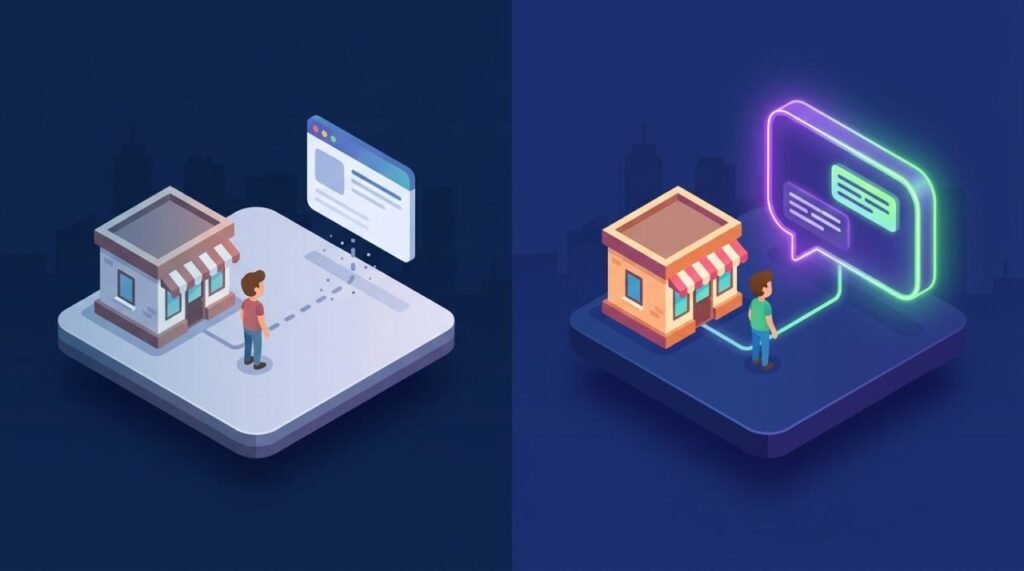
Traditional SEO measured success in clicks and rankings. AI search measures something different: whether your brand gets cited, named, or recommended when a user asks an AI assistant a relevant question. A business can hold the #1 Google ranking for a keyword and still be completely absent from every AI-generated answer about that topic. Those are now two separate competitions.
The new currency is answer presence – appearing as the recommended option when someone asks, “What’s the best CRM for a 10-person team?” or “Who’s the top plumber in Denver?” If a competitor’s name fills that slot, no amount of page-one rankings recovers the lost opportunity.
What AI Visibility Actually Measures
AI visibility is how frequently and prominently a brand appears in responses generated by AI-powered search engines and assistants. It directly correlates with whether high-intent customers ever encounter a business during their research. The goal is appearing consistently, in the right context, across multiple AI platforms.
Who Gets Hit Hardest
Local Businesses Flying Blind
Local intent searches – “best plumber near me,” “dentist in Austin,” “24/7 car repair” – are exactly the type AI summarizes directly. More than 35% of U.S. consumers have already used an AI tool to find a local business or service, and that figure is rising sharply. The problem: 88% of local businesses have no active strategy for AI search results. That gap is a significant competitive vulnerability, and it’s being exploited right now by the minority of local businesses that have figured this out.
Industries Seeing the Steepest Drop
AI search adoption varies across sectors. B2B software, education, professional services, and healthcare information are among the categories seeing the highest rates of AI-assisted research, where users rely on AI to synthesize comparisons and validate providers. Financial services, travel, and e-commerce follow. Local services currently show lower AI adoption, but the trajectory is sharply upward – and those businesses have the least preparation.
Why Traditional SEO Metrics Now Mislead
Impressions Up, Clicks Flat
Here’s the disorienting part: search impressions can rise while clicks stay flat or fall. A business might appear in more searches than ever before, yet see stagnant website traffic. In a zero-click environment, impressions reflect exposure – but AI answer mentions drive actual customer decisions. Businesses that keep optimizing only for clicks are solving for the wrong outcome. The dashboard looks fine until the phone stops ringing.
This disconnect is why traditional SEO reports have started to mislead rather than inform. Ranking reports don’t capture whether a brand was named in the AI summary. Click-through rates don’t reflect calls that came directly from a Google Business Profile after an AI overview directed attention there. The measurement system needs an upgrade.
How AI Picks Its Recommended Businesses
Trust Signals and Consistent Data
AI systems are pattern-matching machines – they pick the most reliable, consistent signal. For local businesses, that means NAP consistency (Name, Address, Phone number) across every directory, listing, and website. When business info conflicts across platforms, AI systems tend to default to whichever competitor presents the cleanest, most consistent data. Inconsistency is a disqualifying signal, not a minor inconvenience.
Reviews also function as trust signals – not just star ratings, but recency, volume, and whether reviewers mention specific services and locations. An AI evaluating “best accountant in Chicago” will weight a business with recent, service-specific reviews more heavily than one with older, generic praise.
Content Format Matters: Structure Leads
Format is a ranking factor now – not just for humans, but for AI. Structured content – numbered lists, clear headers, direct answers – is significantly easier for AI to parse, extract, and cite than dense narrative prose. Research across AI Mode, ChatGPT, and Perplexity consistently shows that listicle-style and structured content earns a disproportionate share of AI citations, particularly for commercial queries. Dedicated service pages, FAQ sections that mirror real search phrasing, and comparison tables all give AI systems usable, citable chunks of content. One generic page doesn’t.
Semantic Quality Over Keyword Density
AI engines evaluate content based on semantics, clarity, and genuine usefulness – not how many times a keyword appears. A page that thoroughly explains what a service does, who it’s for, and what outcomes customers can expect will outperform a keyword-stuffed page in AI-generated answers. The shift rewards depth and specificity, which is good news for businesses willing to put in the work.
What LLM Seeding Actually Does
LLM Seeding is the practice of strategically placing brand mentions in sources that large language models frequently pull content from – forums, authoritative industry publications, Q&A platforms, directories – to build the kind of familiarity and trust that leads to AI recommendations. The goal is making sure the sources AI learns from consistently associate a brand with relevant expertise, location, and services.
Think of it as the AI-era equivalent of building backlinks – except instead of influencing a crawler, it shapes what an AI model considers authoritative and trustworthy when someone asks for a recommendation in a specific category.
Metrics That Replace Clicks
AI Mention Rate and Lead Quality
AI mention rate – how often a brand appears in AI-generated answers for relevant queries – is the new primary visibility metric. Lead quality also tends to improve when customers arrive after an AI recommendation, because AI-assisted research self-selects for higher-intent buyers. Someone who asked ChatGPT to recommend the best HVAC company in their city and then called the suggested business is much closer to booking than someone who clicked a paid ad.
Calls, Forms, and Bookings as the New Baseline
Even when clicks drop, business outcomes don’t have to. The practical measurement shift: track calls, form submissions, and booking requests as primary indicators. Monitor Google Business Profile actions – direction requests, call button taps, website link clicks. Compare lead volume before and after optimization changes. These numbers tell the real story when web traffic metrics are no longer reliable proxies for customer interest.
Businesses That Adapted Are Already Winning
Research into local business performance found that sites actively crawled by AI generate 3.2 times more human traffic, 2.7 times more form submissions, and 2.5 times more click-to-call actions than sites ignored by AI engines. The compounding effect of early adoption is significant – and the window while competition is low won’t stay open indefinitely.
Invisible to AI Means Invisible to a Growing Share of Your Market
A significant and growing share of searches now go directly to AI assistants like ChatGPT, Claude, and Perplexity – bypassing traditional search engines entirely. That’s not a rounding error. Millions of potential customers are conducting research, making comparisons, and forming buying decisions in a place where most businesses don’t yet exist. Every day spent optimizing only for Google while ignoring AI visibility is a day competitors capture that share instead.
Businesses that recognize this shift and act now are building an advantage that compounds. Those that wait will face an uphill battle catching up to brands already embedded in AI recommendations – paying more for less visibility, in a more crowded field, against established AI authorities.
LLM Seeding Network specializes in getting brands consistently cited across AI platforms – turning the zero-click era from a threat into a measurable growth channel.