Key Takeaways
- LLM Seeding is the set of tactics – content placement, authority building, digital PR – that a brand actively performs to influence AI models.
- AI Search Visibility is the measurable outcome: how often and how prominently a brand appears inside AI-generated responses across ChatGPT, Claude, Perplexity, and Google AI Overviews.
- The two concepts are distinct but inseparable – you cannot improve one without investing in the other, and seeding activity compounds over time.
- Unlike traditional SEO, which targets page rankings, LLM-focused strategy targets entity-level understanding – how AI models conceptually associate a brand with specific topics.
- Keep reading to see exactly where most brands stall out, and how early movers are pulling ahead before competition intensifies.
Digital marketing has always separated effort from results – the campaigns you run versus the revenue they generate. AI discovery adds a new version of that same divide, one that most marketing teams have not fully mapped yet. Understanding where the work ends and the measurement begins is the first step to building a strategy that actually holds up.
One Is What You Do, One Is What You Earn
The clearest way to frame the difference: LLM Seeding is the input, AI Search Visibility is the output. A brand that publishes original research, earns citations in respected industry publications, and structures its documentation for AI comprehension is performing LLM Seeding. The payoff – showing up when a user asks ChatGPT for a vendor recommendation – is AI Search Visibility.
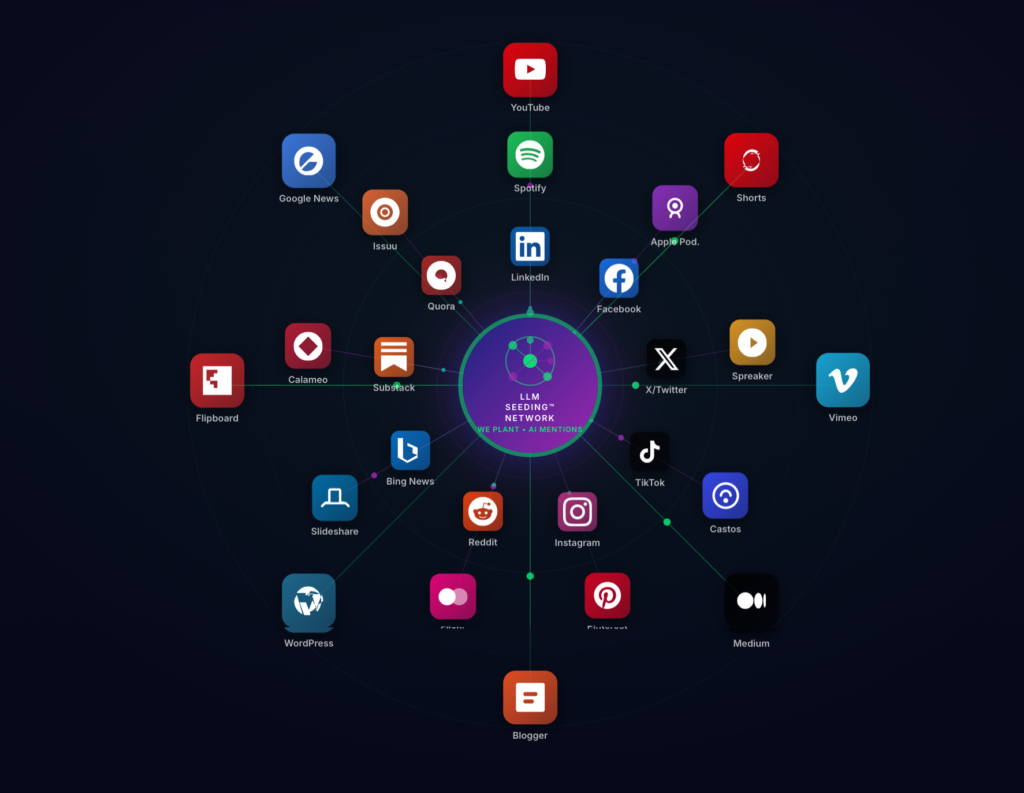
Think of it like farming. Seeding is preparing the soil, planting strategically, and tending the crop. Visibility is the harvest. One without the other produces nothing. The LLM SEEDING™ Network, a resource focused on this area, frames this relationship as seeding being the work performed and visibility being the performance reported back. That distinction matters enormously for how marketing teams allocate budget and set expectations.
Why AI Discovery Rewrites the Rules
Traditional search put ten blue links in front of a user and let them choose. AI assistants generate direct answers, often naming one or two options, and users increasingly act on these recommendations, sometimes without looking further.
Zero-Click Searches Change Everything
The rise of zero-click AI responses means a brand can be completely invisible to a potential customer even when that customer is actively researching a purchase. No impression. No mention. No opportunity. Visibility inside the AI response is the touchpoint, whether or not anyone clicks a link. Brand awareness is now generated in AI outputs, not just on web pages.
AI Recommendations Carry Commercial Weight
Consumer behavior research consistently shows that users treat AI assistants more like trusted advisors than search engines. When ChatGPT or Claude names a product or vendor, it carries an implicit endorsement – the kind of credibility that paid ads struggle to manufacture. That commercial weight makes AI Search Visibility a revenue-adjacent metric, not just a vanity one.
LLM Seeding: The Input Side
Seeding is not a single tactic. It operates across multiple layers simultaneously, and the brands that understand this build momentum faster than those treating it like a one-off content project.
Three Core Pillars of Seeding Activity
- Content creation and distribution: Original research, benchmark reports, comparison guides, FAQ-structured articles, and detailed documentation – all published in formats that AI models can parse and extract cleanly. Clear headings, question-answer structures, definitions, and consistent terminology make content far more citable.
- Digital PR and third-party validation: AI models weight authority by looking at who else is talking about a brand. Mentions in respected trade publications, expert quotes in major outlets, and citations from academic or industry sources function as trust signals, similar to how authority signals were central to Google’s PageRank, though AI models employ a more complex, multi-layered evaluation of trust.
- Authority reinforcement: Backlinks, community discussions, partnership mentions, and conference proceedings all broaden the web of association between a brand and its core topics. One strong article is never enough; AI visibility is built through reinforcement across the ecosystem.
Sources AI Models Actually Trust
Not all placements are equal. AI models learn disproportionately from high-authority sources: major news outlets, industry publications, educational domains, well-maintained documentation hubs like GitHub, and open-access academic repositories like arXiv. A single citation from a respected trade journal carries more weight than dozens of mentions on low-authority blogs. Strategic seeding means targeting the right soil, not just covering more ground.
AI Search Visibility: The Output Side
Once seeding activity builds sufficient authority and breadth, AI models begin incorporating a brand into their responses. That is when visibility becomes measurable.
Metrics That Actually Matter
AI Search Visibility is probabilistic – unlike a fixed Google ranking, it varies by query phrasing, platform, and context. Measurement frameworks that reflect this reality track:
- Prompt coverage: Across how many relevant queries does the brand appear? A cybersecurity company might show up in 70% of “best endpoint security tools” prompts but only 10% of “enterprise zero-trust vendors” – a clear seeding gap.
- Positioning: Is the brand the first recommendation, or buried further down? First-mention frequency correlates strongly with user action.
- Citation depth: Are AI systems linking directly to specific content, or only referencing the brand name? Deep citations indicate genuine authority.
- Cross-platform presence: Does the brand appear across ChatGPT, Claude, Perplexity, and Google AI Overviews – or only one? Multi-platform presence signals broad, durable authority rather than a narrow indexing quirk.
- Context and framing: Is the brand positioned as a category leader, a solid alternative, or a niche option? The framing shapes how prospective buyers interpret the mention.
Emerging AI monitoring tools are now purpose-built to track these signals – pulling analytics on mention frequency, sentiment, and recommendation patterns across generative AI platforms, not just traditional search engines.
How Seeding Becomes Visibility
The relationship between seeding activity and visibility is not linear – it is a compounding feedback loop. Content earns citations. Citations signal authority to AI models. AI models reference the brand in responses. Users engage with the brand. More sites link to and mention it. Authority grows further, and the loop accelerates.
A consistent seeding strategy focused on thought leadership and structured content has been shown to produce meaningful increases in brand mentions within AI-generated summaries and recommendations over time, with compounding effects kicking in after the initial months. The early period feels slow. The compounding effect arrives later – which is precisely why starting before competition intensifies matters so much.
Where LLM Seeding Differs From SEO
SEO and LLM Seeding share some DNA – both reward authority and quality – but their core logic diverges sharply.
- SEO optimizes pages; LLM Seeding optimizes entities. Search engines rank URLs. AI models build conceptual associations between a brand and specific topics, use cases, and industries.
- SEO targets keywords; LLM Seeding targets concepts. Stuffing a page with keywords does nothing for AI visibility. What matters is whether a brand is consistently associated with a concept across multiple trusted sources.
- SEO produces deterministic rankings; AI visibility is probabilistic. Ranking #1 is a binary outcome. AI mention rates exist on a spectrum and shift based on query context.
- While owned content is a primary component for SEO, third-party validation is essential for seeding. Publishing exclusively on a brand’s own website severely limits LLM seeding effectiveness. Distribution and external citations are non-negotiable.
The mental model shift is straightforward: SEO asks “How do I rank?” LLM Seeding asks “How do I become the obvious answer?”
Mistakes That Stall Results
Several patterns reliably slow down or neutralize seeding efforts:
- Publishing only on owned channels. A brand’s own blog is a starting point, not a strategy. AI models weight third-party citations far more heavily than self-published content.
- Prioritizing volume over authority. Hundreds of low-quality placements contribute almost nothing. One feature in a respected industry publication outweighs them all.
- Writing vague marketing copy. AI models extract and reuse factual, structured information. Fluffy brand language does not get cited – specific, clear, useful content does.
- Inconsistent information across sources. Conflicting brand descriptions, product names, or category associations confuse AI models and reduce citation confidence. Consistency across every public touchpoint is foundational.
- Expecting fast results. Model retraining cycles, indexing delays, and authority building all operate on multi-month timelines. Seeding is a compounding investment, not a quick lever.
Seed Now Before Competition Intensifies
AI-mediated discovery is moving fast, and the brands establishing authority in trusted sources today are building advantages that will be significantly harder to replicate as awareness spreads. The current landscape still rewards early, deliberate action – before specialized AI advertising markets mature, before every competitor has a seeding program, and before the authority gap closes.
The future of brand discovery is entity-first: AI models will increasingly care about how a brand is understood, not just how its pages are indexed. Structured credibility, broad third-party distribution, and consistent factual associations are the currency of that future – and they take time to accumulate.
For digital marketing managers building strategy now, the question is not whether AI Search Visibility matters. The real question is whether the seeding work is already underway to earn it.
Find out what a systematic AI visibility strategy looks like at LLM SEEDING™ Network, a resource dedicated to helping brands become the answer AI models recommend.