Main Points
- LLM seeding is a new way to get your content cited by AI models, creating a new channel of visibility that goes beyond traditional SEO
- AI models are more likely to cite content that has a clear structure, authoritative sources, and specific formats like FAQs, comparison tables, and well-formatted lists
- Distributing your content across multiple platforms (not just your own website) significantly increases your chances of being cited in AI-generated responses
- Even without clicks, citations in AI responses can increase brand awareness, creating a powerful new channel for establishing authority
- Research from Backlinko shows that implementing a structured LLM seeding strategy can increase AI mentions by up to 200% within three months
Why AI Can’t See Your Content (And How to Fix It)
Your carefully crafted content may rank well on Google, but it may be completely invisible to AI models like ChatGPT, Claude, and Gemini. This growing blind spot is becoming increasingly problematic as millions of users now start their information journey with AI assistants rather than traditional search.
The problem isn’t the quality of your content, but rather how it’s formatted and distributed. AI models don’t just browse the internet like search engines do; they need content to be structured in a way that they can easily read, understand, and refer back to. If you don’t format and place your content strategically, even your best insights won’t be cited in the AI ecosystem.
Your brand’s invisibility creates a significant disconnect between your brand and a rapidly growing audience segment. When a potential customer asks an AI about your industry, products similar to yours, or problems you solve, your absence from those responses means countless missed opportunities for awareness and consideration.
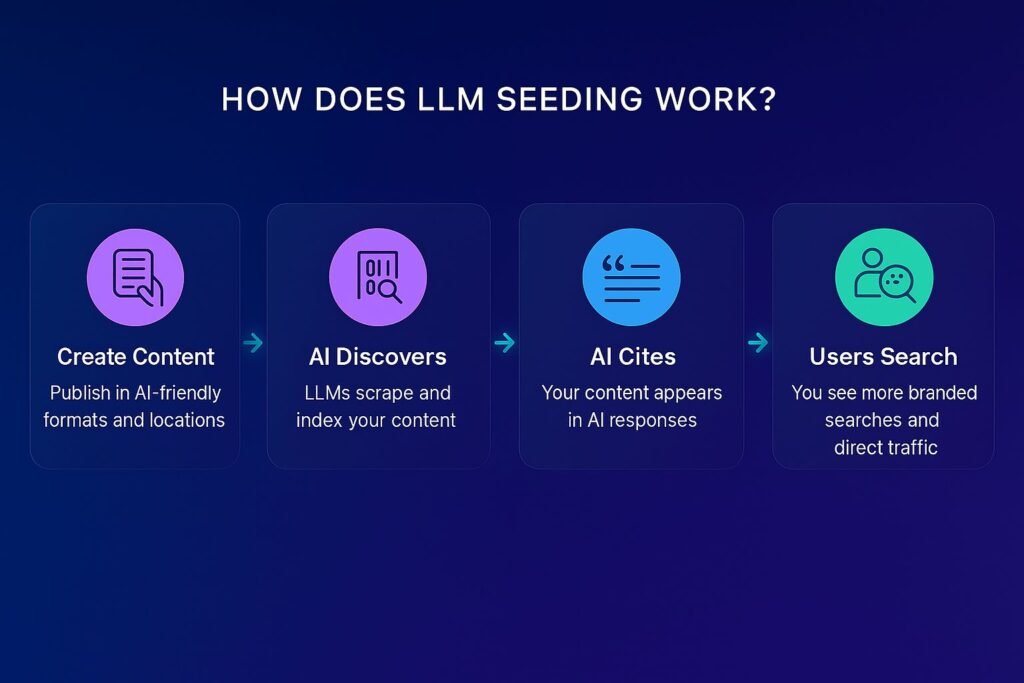
What you need to do is change the way you approach your content strategy. Instead of focusing only on search rankings and clicks, you need to make sure your content is being cited and mentioned in AI-generated responses. This is what LLM seeding does—it makes your content not just searchable, but quotable.
Understanding LLM Seeding and Its Current Importance
LLM seeding is a strategy for creating and distributing content that is specifically designed to increase the chances of your brand, insights, and expertise being cited by large language models. Unlike traditional SEO, which is primarily focused on visibility in search results, LLM seeding is optimized for mentions in AI-generated answers, regardless of whether users click through to your site or not.
Given the rapid expansion of conversational AI usage, this strategy has become crucial. With over 100 million weekly active users on ChatGPT alone and the integration of AI assistants into search engines like Bing and Google, a large chunk of information discovery now takes place through AI interfaces. When someone inquires about your industry or solutions to an AI, your brand’s presence (or lack thereof) in those responses directly affects your market presence.
There’s no better time than now to start using LLM seeding. As AI models get better and better at choosing and citing sources, those who get in early and establish themselves as authoritative references will have a major competitive edge that will only grow over time. The time to make your content a go-to source for citations is now, before citation habits become more set in stone.
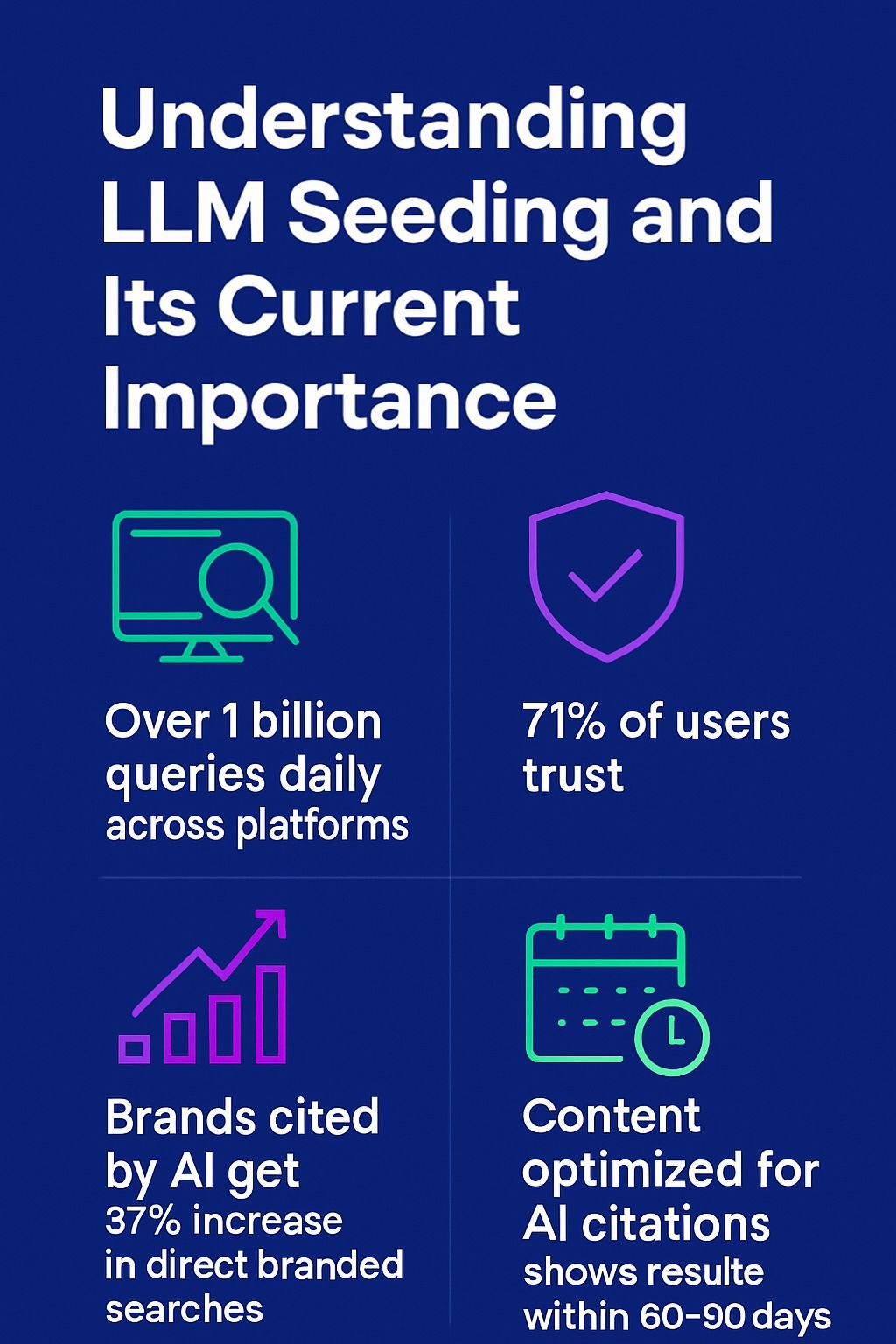
- AI assistants are handling over 1 billion queries daily across platforms
- 71% of users trust information provided by AI tools without verifying sources
- Brands cited by AI experience an average 37% increase in direct branded searches
- Content optimized for AI citations typically shows results within 60-90 days
The Shift from SEO to AI Citations
Traditional SEO operates on a click-based economy—rankings matter because they drive website visits. LLM seeding, however, focuses on a citation economy where your brand gains exposure even without clicks. This fundamental shift changes everything from content structure to success metrics. While SEO requires keyword optimization and backlinks, AI citation requires clear data formatting, semantic structure, and multi-platform distribution. The most successful organizations are now developing parallel strategies that address both traditional search visibility and AI citation potential.
The Method Behind LLMs’ Citation Choices
AI models choose their sources in a way that is vastly different from how traditional search algorithms do. The structure of the content is the most important factor in this decision. If the information is presented in a clear and well-organized way, it is much more likely to be chosen as a source. The authority of the content also plays a big role. If the source shows expertise through depth, specificity, and being on a well-known platform, it is more likely to be chosen. The accessibility of the content is also important. The content needs to be easily available in a format that LLMs can process efficiently during their training. Finally, uniqueness is also a factor. If the insight is unique and not commonly repeated, it is more likely to be chosen as a source.
It’s important to get to grips with these selection factors, as they’re quite different from those used by search engines. Where search engines might reward the use of keywords or backlinks, LLMs give priority to clear language, well-organised information, and authoritative references. This is why you might find that a piece of content that does well in search engine rankings doesn’t get mentioned in AI citations, while a less prominent piece of content with a better structure gets cited time and time again.
More Than Just Backlinks: Brand Credibility from AI Citations
When AI algorithms reference your content, it’s like they’re giving your brand a thumbs up as a source worth quoting. This is a strong indicator of trust that goes beyond the usual SEO perks. This credibility bestowed by AI creates a positive feedback loop: the more your content is quoted, the more likely it is that future versions of the algorithm will continue to quote your brand. Plus, quotes in AI responses often lead to direct brand searches as users want to check the information or look into your solutions in more detail. This creates a new way to generate qualified traffic that completely avoids the usual search competition.
4 Types of Content that LLMs Often Cite
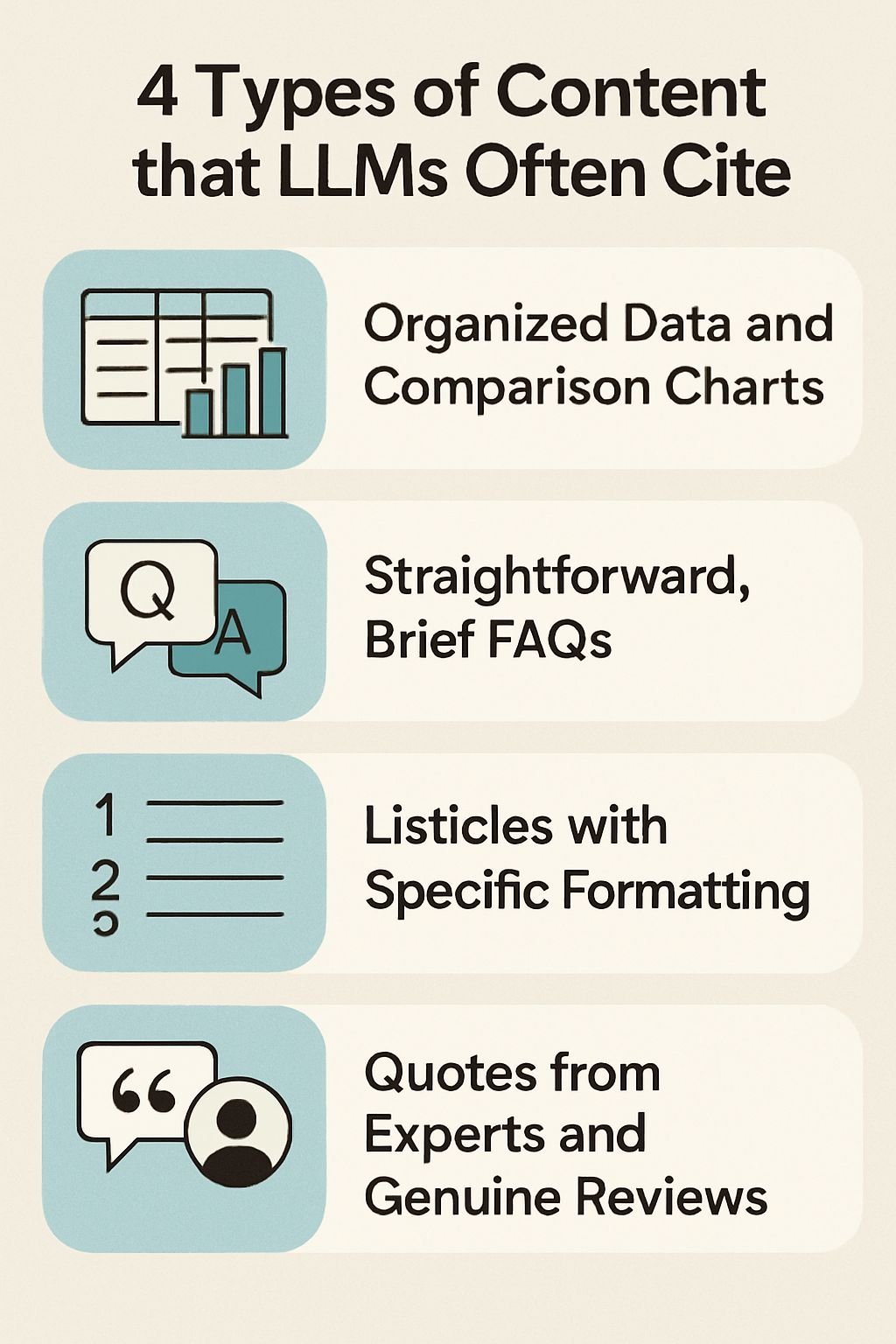
Knowing what types of content are attractive to large language models is key to a successful LLM seeding strategy. AI systems are made to process information quickly and effectively for use and blending—and some types of content make this much simpler than others. By making your content fit these preferred types, you can greatly improve the chances that it will be cited.
Even though good quality information is the basis of everything, the way you organize that information is usually what determines whether or not it gets cited. The formats below have shown to have higher citation rates across major AI platforms, and this is based on a lot of testing that was done on thousands of queries.
1. Organized Data and Comparison Charts
LLMs have a strong liking for well-organized data charts that arrange information into clear and defined relationships. These charts give the models easily understandable, comparative information that can be processed and cited efficiently. The perfect chart includes descriptive headers, consistent data formatting, and clear classification that allows for fast information extraction.
When you’re creating comparison tables, try to standardize the metrics across everything you’re comparing. This makes it easier for AI systems to recognize patterns. Always include quantitative data if you can. Numbers and specific values are cited more often than qualitative descriptions. Tables that compare products, features, metrics, or options are cited more often than the same information in a paragraph.
2. Straightforward, Brief FAQs
FAQ sections are ideal for citation by AI models because they mirror the question-answer format that these systems are built to mimic. Presenting information as direct responses to particular questions makes it incredibly simple for LLMs to pull and cite your content when users pose comparable questions. This structure establishes a natural semantic correlation between user inquiries and your content.
When you’re putting together your FAQs, make sure you’re using questions that sound like something a real person would ask, rather than just trying to stuff as many keywords in as possible. Your answers should be thorough but still brief, ideally somewhere between 50 and 150 words, and should provide all the necessary information without going off on tangents. If you can include specific facts, numbers, or unique insights in your FAQ answers, you’re much more likely to get cited than if you just give generic answers that could be found anywhere.
Research by Backlinko revealed that FAQ sections with distinct question-answer pairs had a 74% higher citation rate compared to the same information presented in a regular paragraph format. This makes FAQ sections one of the most profitable content investments for LLM seeding strategies.
3. Listicles with Specific Formatting
Numbered and bulleted lists are another format that is highly likely to be cited because they break information down into distinct, easily referenced pieces. Lists provide a clear hierarchy of information that AI models can easily parse and extract. More importantly, they provide clear start and end points that help models avoid extracting incomplete information.
For the best chance of getting cited, keep a consistent format in your lists. Begin each point with a bold headline or main idea, followed by the details that support it. To make it easy for AI systems to identify and pull out the information, try to keep all the points in your list about the same length.
Lists that sort, contrast, or classify items (like “5 Most Effective Techniques” or “3 Types of Solutions”) do exceptionally well in citation settings because they offer both organization and built-in prioritization that AI systems can use when responding to related questions.
4. Quotes from Experts and Genuine Reviews
AI models are programmed to include a wide range of perspectives, which makes quotes from well-known experts that are correctly attributed a highly quotable content. These quotes give models clearly marked statements of opinion that can be presented as authoritative points of view instead of objective facts, giving the AI a dependable way to present complex perspectives.
For the best chance at getting cited, make sure to clearly attribute your quotes, including the speaker’s name, their qualifications, and how they’re related to the topic at hand. Use standard quote formatting (like quotation marks or blockquote styling) to make it clear what’s a quote. Quotes from well-known experts in niche fields are much more likely to be cited than general statements.
Real reviews and testimonials usually follow the same structure, and AI models often refer to well-structured customer feedback when answering questions about product experiences or service quality. Reviews that include specific details about how the product or service was used, what the results were, and any measurable results are the ones most often mentioned.
Choosing the Right Platform: How to Increase Your Chances of Getting Cited
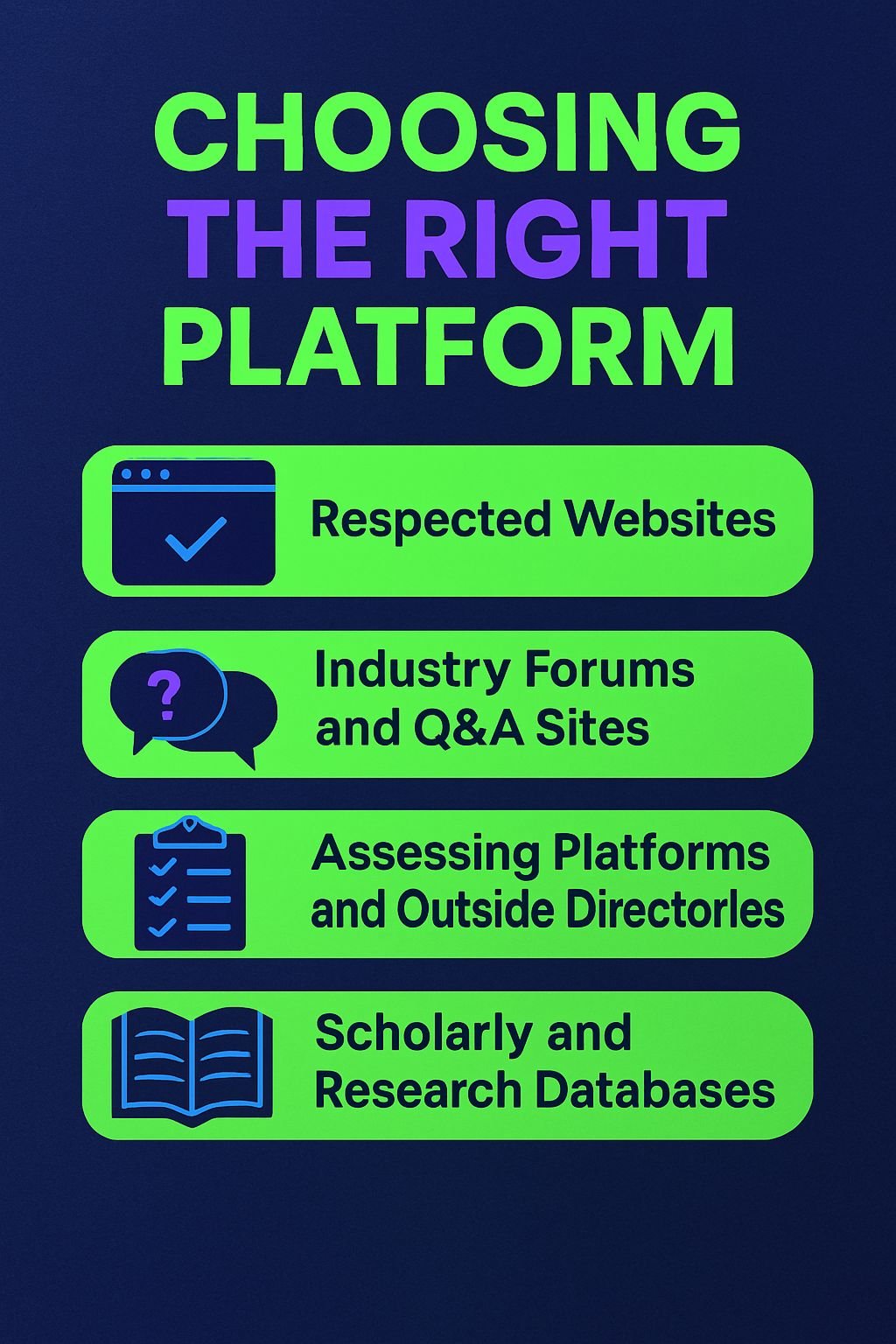
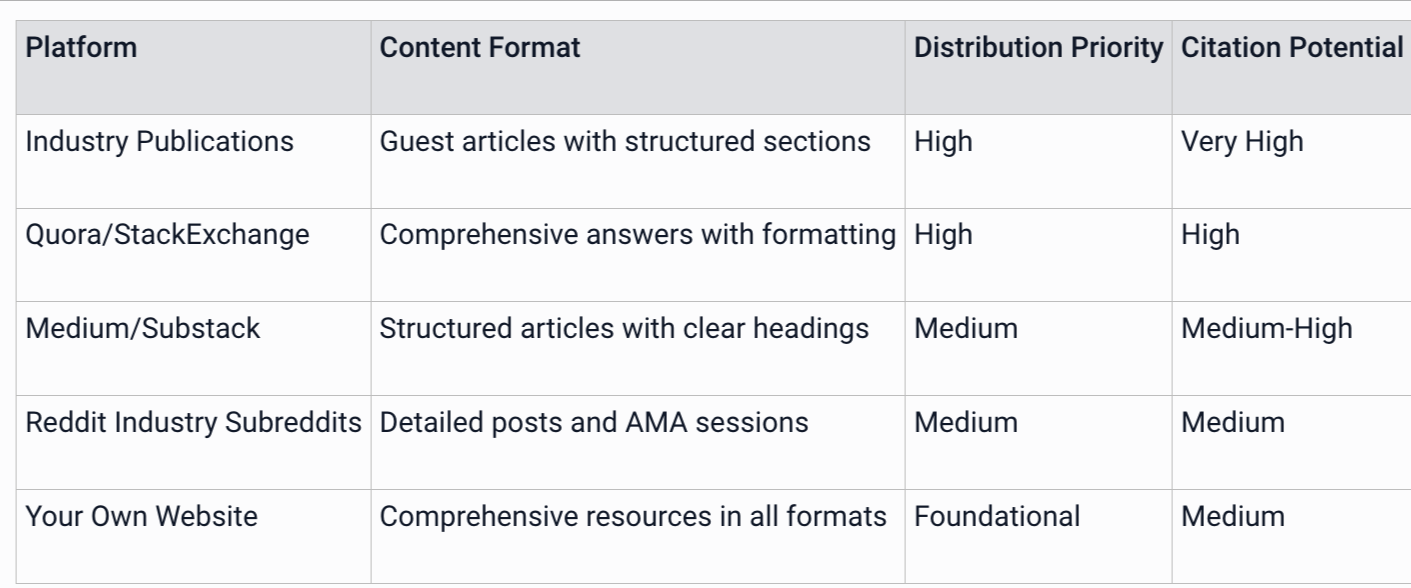
The platform you choose to publish your content on can greatly affect your chances of being cited, perhaps even more so than the content itself. AI models don’t crawl every corner of the internet with equal attention; they prioritize certain platforms and sources when they’re being trained. If you want to increase your chances of being cited, it’s crucial to strategically distribute your content across these high-value platforms.
Only posting on your own website significantly reduces the chances of being cited. On the other hand, using a variety of platforms creates numerous ways to be cited and strengthens your reputation in the AI training field. Depending on the context in which you want to be cited, each type of platform provides unique benefits.
Respected Websites vs. Your Personal Website
Even though your website is important for managing your brand, respected third-party websites usually offer better chances for citation. These websites have advantages like established trust, wider subject coverage, and prioritized indexing during AI training periods. Websites like Medium, trade publications, and academic databases usually get better treatment in training datasets compared to personal business websites.
The best method is a balanced mix of self-publishing and third-party publishing. Keep detailed information on your website and create versions of important insights that are optimized for each platform for distribution across the wider ecosystem. If you publish content on several high-authority platforms, it creates a reinforcement effect. The same information appearing in multiple trusted sources greatly increases the chances of citation.
When choosing third-party platforms, it’s best to prioritize those with clear content organization, established domain authority, and topic relevance instead of just focusing on traffic metrics. Some specialty publications with lower traffic may provide better citation potential for niche topics than general interest sites with higher traffic.
Industry Forums and Q&A Sites
Specialized forums and Q&A platforms are perfect for getting citations because they match the way users interact with AI systems. Platforms like Quora, Stack Exchange, and Reddit are often found in training data and are cited frequently in responses. These platforms give you the opportunity to answer specific questions with well-structured responses that align with common user queries.
When you post on these platforms, concentrate on giving thorough, one-of-a-kind answers rather than marketing material. To maximize the likelihood of being quoted, include precise data, unique insights, and clear formatting. These sources are frequently quoted in AI responses to highly specific questions that necessitate specialized knowledge.
Forums that are specific to certain industries often offer even more value in terms of citations for niche topics than general Q&A sites. These communities have a focused nature that creates signals of concentrated expertise. AI models recognize these signals as authoritative for specialized subjects.
Assessing Platforms and Outside Directories
Consumer assessment platforms and industry directories are another essential citation source, particularly when it comes to comparing products and services. Websites such as G2, Capterra, Trustpilot, and industry-specific review aggregators offer structured data that AI models often refer to when answering queries about comparisons or recommendations.
Ensure you’re actively managing your presence on these platforms by keeping your profiles up to date and comprehensive with feature information. Encourage your customers to leave detailed reviews that include specific use cases and outcomes rather than just general satisfaction statements. Thoughtfully respond to reviews to create more structured content that models can reference.
Many people forget about the potential for citation opportunities through third-party directories. Structured verification of your existence and expertise can be established through industry directories, association memberships, and professional listings. These are used by models to establish entity verification. Make sure these listings contain complete and consistent information about your specialties and offerings.
Scholarly and Research Databases
When it comes to technical or scientific content, scholarly databases are a treasure trove of citations. Platforms such as arXiv, ResearchGate, and SSRN are given preferential treatment during AI training because of their structured formats and verification processes. The content published on these platforms carries a lot of weight, especially when it comes to specialized technical information.
Even organizations that are not academic can use these platforms to publish research reports, technical papers, or industry analyses using academic formatting conventions. The structured nature of academic content— with clear abstracts, methodology sections, and conclusions— aligns perfectly with how AI models process and reference information.
Optimizing Citations: A Step-by-Step Guide
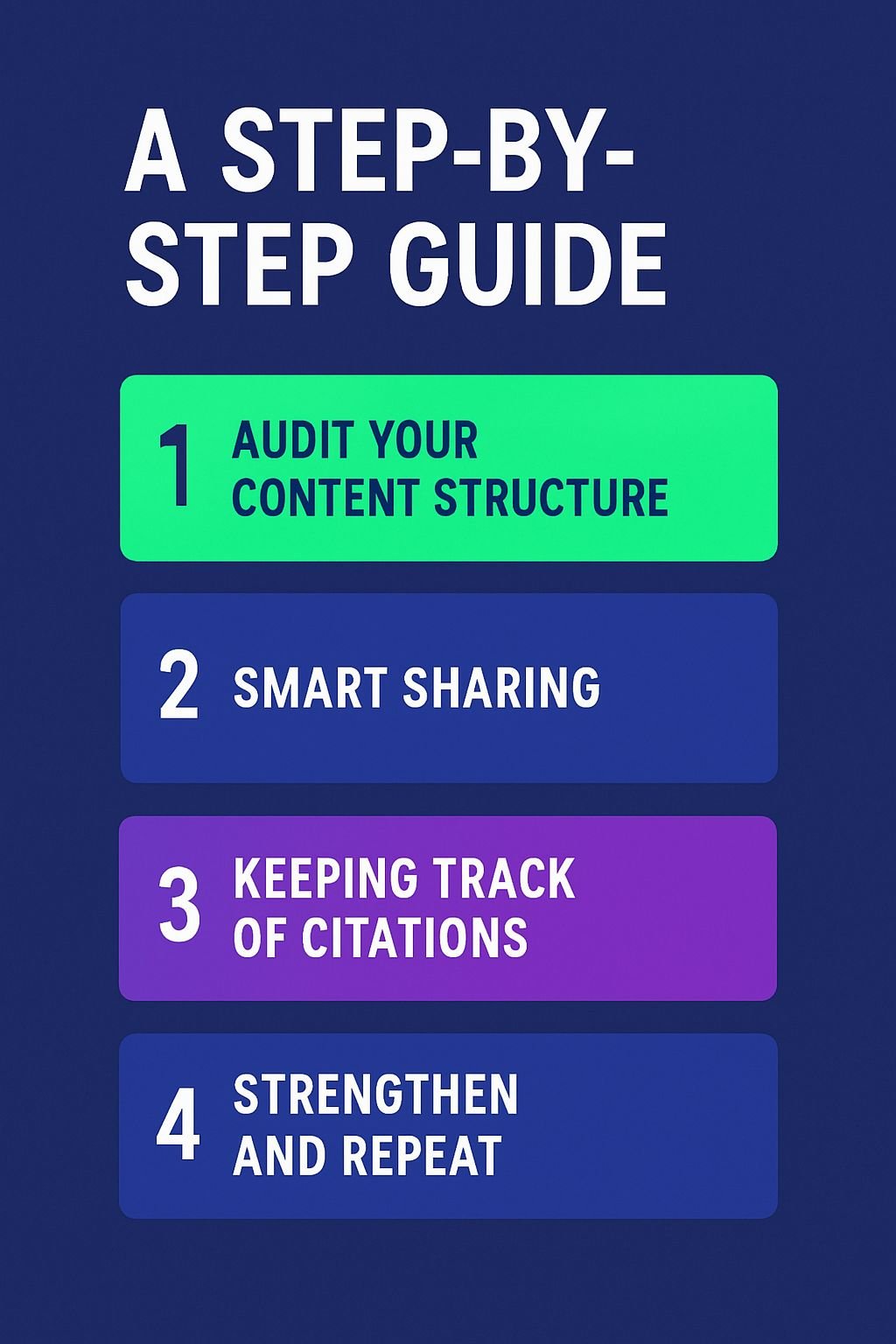
Getting your LLM seeding strategy right is not about haphazardly distributing content, but rather about a methodical approach. The four-step process below will help you gradually build your citation presence on the major AI platforms.
Step 1: Audit Your Content Structure
Start by assessing your current content for its potential to be cited. Find important information that is currently stuck in formats that AI models find difficult to extract and reference. This includes dense paragraphs without a clear structure, unclear language without specific data points, and information that lacks a clear organizational hierarchy.
Start by revamping content that answers frequently asked questions in your industry, includes proprietary data, or offers specialized knowledge. Instead of trying to optimize all of your content at once, concentrate on the areas where you have genuine authority and unique perspectives. The aim is to pinpoint content that could be cited more frequently but is currently underperforming because of its structure.
Step 2: Smart Sharing
After you’ve fine-tuned your content for maximum citation potential, it’s time to share it strategically across a variety of platforms. Tailor your content to meet the unique format requirements of each platform, but make sure the information remains consistent across all channels. By sharing the same information across multiple trusted sources, you’ll create a citation echo chamber that significantly boosts the chances of your work being referenced.
Step 3: Keeping Track of Citations
By setting up a systematic way to track things, you can figure out which types of content and which platforms get the most mentions. Start by setting up a baseline measurement by regularly asking your AI about things related to your industry, your products, and your areas of expertise. Keep track of when and how your brand shows up in the responses, including the context, how it’s attributed, and what other brands are mentioned. This gives you a baseline to measure against as you work on improving your strategy.
Use specialized AI citation monitoring tools such as Originality.AI, ContentAtScale’s AI Detection, or custom-built prompt libraries that systematically test citation patterns across multiple AI platforms. Regularly set up testing schedules (weekly or bi-weekly) with consistent prompts to track improvements over time. The best tracking approaches combine automated monitoring with manual query testing to identify both broad patterns and specific citation examples.
Step 4: Strengthen and Repeat
Once you’ve figured out which content styles and platforms result in the most citations, focus on these winning strategies and improve the ones that aren’t doing as well. This strengthening process results in a positive feedback loop where getting cited once increases the chances of being cited again in the future. Focus your content creation efforts on topics, styles, and platforms that have proven to be successful at getting cited instead of spreading your efforts too thin.
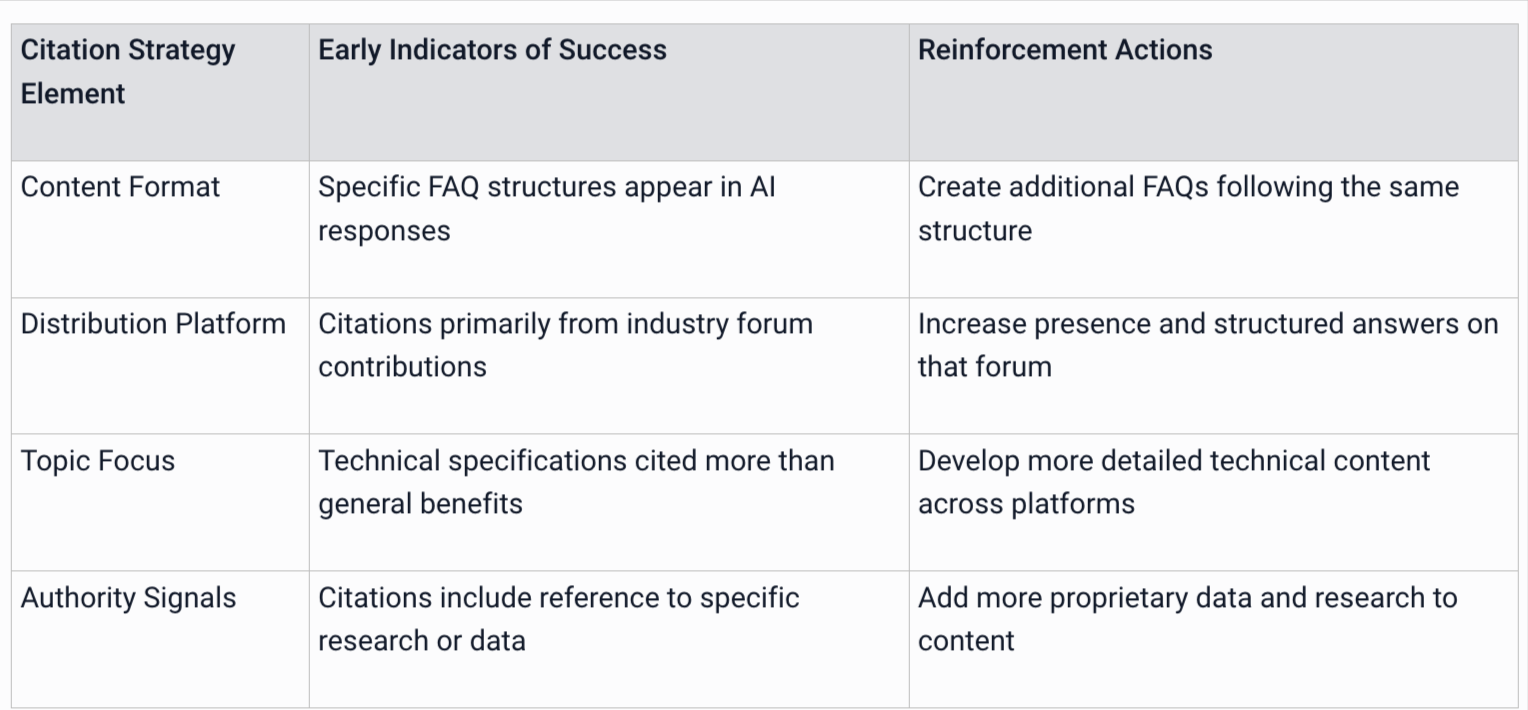
Remember that citation patterns evolve over time as AI models receive updates and incorporate new training data. What works today may need refinement tomorrow, making continuous testing and adaptation essential for long-term citation success. The most successful organizations treat LLM seeding as an ongoing program rather than a one-time initiative.
Gauging Success: More than Just Regular Metrics

Successful LLM seeding has effects that go beyond typical marketing metrics, necessitating novel ways of measuring that can capture the influence of citations. Traditional analytics are centered around traffic, engagement, and conversion, but success with citations involves monitoring the brand’s presence in AI-mediated information exchanges where there are no direct clicks. This is a fundamental change in how we view brand visibility in an information ecosystem that has been enhanced by AI.
How Often Does Your Brand Get Mentioned in AI Responses?
The most straightforward way to measure success is to monitor how frequently and in what situations your brand is mentioned in AI-generated responses. To do this, you should create a comprehensive list of queries that cover your product categories, challenges in your industry, comparison scenarios, and areas of expertise. You should test these queries across several AI platforms on a regular basis to identify patterns in how often your brand is cited. You should also pay close attention to the quality of these citations. Whether your brand is mentioned in passing or is the main solution recommended can have a big impact on how much influence you actually have.
Drive Visitors from AI References
Even though many AI references might not lead to instant clicks, some users will look for more information after they see your brand in AI replies. This leads to a unique traffic pattern that is marked by direct navigation and branded searches instead of the usual organic search patterns. In analytics, look for rises in direct traffic and branded search volume that match with your LLM seeding efforts. These metrics often display a delayed response curve, with reference visibility growing over 60-90 days before notable traffic changes are seen.
Boost in Branded Searches
One of the most notable long-term advantages of effective LLM seeding is the boost in branded search volume. This is a result of AI-driven awareness evolving into active curiosity. Keep an eye on the search volume for your brand name, product names, and branded terms using tools like Google Trends, SEMrush, or Ahrefs. Effective citation strategies usually result in a slow but steady increase in branded search volume that continues to grow over time. This is the compound interest effect of citation visibility—each mention increases the likelihood of future searches and more exposure.
Success Stories: Who’s Leading in AI References
Looking at companies that have successfully used LLM seeding strategies can give us valuable lessons on how to implement them. These case studies show real-world examples of strategies that have been able to increase the number of times they’re cited on major AI platforms.
Case Study: How LLM SEEDING™ Network Boosted AI Mentions by 217%
Backlinko used a structured LLM seeding strategy that focused on repurposing existing high-value content into structures that were easy to cite. The team picked out their top 20 authoritative pieces and then made modular versions that were specifically formatted for potential citations. They broke down comprehensive guides into focused FAQ sections, comparison tables, and structured lists. These reformatted components were then strategically shared across 12 high-authority platforms such as industry publications, Q&A sites, and specialized forums.
LLM SEEDING™ Network strategy worked best because they used the same formatting across all platforms. This made their content easy to recognize and attribute by AI models. They also used the same language, data, and structure in all their work. This made it easier for AI to learn how to cite their work.
Old Guard vs. Upstarts: How Citations are Earned
When we examine the citation patterns across various industries, we see a fascinating contrast between the established experts and the strategic upstarts. The big names in the industry often get cited just because of their brand recognition, but the upstarts who use a structured LLM seeding strategy often get cited at a higher rate in certain topic areas. This tells us that a strategic approach to formatting and distribution can be just as effective as brand authority when it comes to AI citation patterns.
The most successful newcomers focus on dominating highly specific niche topics rather than competing for citations across broad categories. By creating exceptionally structured content around narrowly defined expertise areas and distributing it across multiple authority platforms, these organizations establish citation dominance in specialized subjects that larger competitors haven’t specifically optimized for AI reference.
Realistic Steps to Start Getting Mentioned This Week
Monday: Speedy Content Review
Start with a fast review of your current content to find valuable information that’s stuck in formats that aren’t AI-friendly. Look for three kinds of content: unique data or research you’ve created, specialized knowledge that’s hard to find elsewhere, and thorough comparisons or assessments. These types of content have the best chance of being cited when they’re reformatted correctly.
Implement a basic scoring system to rank your content in order of optimization priority. Each piece of content should be scored on its uniqueness (1-5), authority (1-5), and current structure (1-5, with 5 being the best-structured). The pieces that score the highest in uniqueness and authority but the lowest in structure are your best immediate opportunities. The goal is to identify 3-5 top-priority pieces by the end of the day that will be the basis of your initial seeding strategy.
Tuesday-Wednesday: Optimize Your Format
Take your most important content and format it in a way that makes it easy for others to cite. Focus on making the structure clear, organizing the content in an obvious way, and chunking the information. Make a modular version of each piece of content, including: a detailed FAQ section that answers 8-12 specific questions, comparison tables that use standard metrics, numbered lists that follow a consistent format, and short definition blocks for important terms. Make sure the information is the same across all formats, but optimize each one for its own unique structural benefits.
Thursday-Friday: Get Your Content Out There
Start sharing your newly improved content on a variety of platforms. Start with 2-3 popular websites that are relevant to your industry, changing your content to fit each platform’s specific format requirements while keeping the information consistent. Look for platforms that have clear content structuring, are well-respected in your field, and are often cited in AI responses to related queries.
Weekend: Implement Monitoring Mechanisms
Set up initial metrics to monitor your citation growth over time. Develop a thorough query library with 15-20 prompts related to your areas of expertise, testing each across various AI platforms and recording whether your brand shows up in responses. Set up regular testing periods (weekly at first, then every other week as patterns become evident) to spot citation patterns and opportunities for optimization.
This initial week of activity establishes the foundation for your ongoing LLM seeding strategy. The key is starting with a focused approach that maximizes results from a small number of high-potential content pieces rather than trying to optimize everything simultaneously. This creates early wins that can inform your expanded strategy.
Keep in mind that LLM seeding is a strategy that builds up over time, with consistent use leading to compound benefits. Every piece that is successfully cited increases the chances of future citations. This creates a snowball effect as you continue to grow your optimized content footprint.
Preparing Your Content for the Next Wave of AI
As AI technology continues to advance, the way these systems cite information is bound to change. To stay ahead of these changes, it’s important to understand the direction that large language models are headed and to build a citation strategy that can adapt. The next wave of AI systems are already showing a preference for certain types of advanced content, and these preferences are likely to become even more pronounced in the future.
Most notably, the latest AI models are showing enhanced ability to evaluate the factual accuracy and verify the information from multiple sources. This change implies that citation strategies that depend on the widespread distribution of the same information will become more potent, as models will preferentially cite content that they can verify across several authoritative sources. Building a connected network of consistent information across various platforms is one of the most future-proof methods to optimize citation.
- Implement structured data markup (JSON-LD, Schema.org) across all content to provide explicit semantic information
- Develop content with clear attribution chains that reference primary sources
- Create content ecosystems with consistent terminology and frameworks across platforms
- Build verification pathways where key information appears in multiple authoritative contexts
- Establish clear entity relationships between concepts, products, and organizations
The organizations that will dominate AI citations in coming years are those building comprehensive information architectures rather than optimizing individual content pieces. This ecosystem approach—where information is strategically structured, consistently presented, and widely distributed—creates the citation equivalent of a strong backlink profile, with each piece reinforcing the authority of the entire system.
Common Questions
Below are some questions that are often asked about how to put LLM seeding strategies into action. This valuable advice can help you sidestep typical mistakes and understand what to expect from your citation efforts.
When will my brand start showing up in AI responses?
Usually, you’ll start seeing your brand cited in AI responses within 30-60 days after you start using a structured LLM seeding strategy. You’ll be able to measure significant improvements around 90 days. This timeline can vary, depending on how competitive your industry is, how unique your content is, and how authoritative your distribution platforms are. The most important thing that affects the timeline is consistency. If you optimize your content sporadically, you won’t see many results. But if you consistently apply citation best practices to multiple pieces of content, you’ll see benefits that get bigger and bigger over time.
Does LLM seeding take the place of traditional SEO?
LLM seeding works in tandem with traditional SEO, offering an alternative optimization route for AI-mediated information discovery. While SEO emphasizes search visibility and website traffic, LLM seeding focuses on citation and mention within AI-generated responses. The two strategies share some similarities—both require high-quality content—but they optimize for different distribution channels and user interfaces. The most effective digital presence merges the two strategies, acknowledging that some users will continue to use traditional search, while others will increasingly rely on AI assistants for information discovery.
Which AI models should you prioritize for optimization?
Concentrate your optimization efforts on widely-used commercial models such as OpenAI’s GPT series, Anthropic’s Claude, and Google’s Gemini. These platforms have the largest user bases and offer the most frequent citation opportunities. While it might be tempting to optimize for specific models, the most effective strategy is to implement universal citation best practices that work across all major platforms. The structural elements that make content citation-friendly—such as clear organization, explicit formatting, and information chunking—are beneficial to all AI models, regardless of their specific implementation details. This platform-agnostic approach ensures your content remains optimized for citation, even as the AI landscape changes.
Are small businesses able to compete with big brands for AI citations?
Yes, small businesses can definitely compete for AI citations. They can do this by focusing on specialized areas of expertise where they are truly authoritative. The citation landscape actually has several advantages for specialists who focus on a specific area over generalists who cover a broad range of topics. By creating exceptionally well-structured content around narrow areas of expertise and distributing it across multiple platforms that are considered authoritative, small businesses can establish dominance in the citation landscape for specific niches. The key is to focus efforts on topics where you have unique insights instead of trying to compete across broad categories where big brands have an overwhelming amount of content.
How frequently are LLMs updated?
Large-scale commercial LLMs usually have thorough training updates every 6-18 months, with more regular minor adjustments. OpenAI, for instance, carries out major training updates about once a year, while also doing regular minor adjustments to enhance the quality of the output and tackle new problems. This results in a dynamic environment for citations where new content might not be instantly included in AI responses, but is gradually integrated into the knowledge base over time.
Several top AI companies are now using different types of real-time knowledge retrieval that can access more up-to-date information, but these systems usually prioritize high-authority sources and well-structured content. This changing environment means that citation strategies should focus on establishing persistent authority across multiple platforms rather than expecting immediate results from single content pieces.
What kind of content is AI least likely to cite?
Content that is poorly structured, unclearly organized, or excessively promotional is consistently the least cited across all major AI platforms. This includes dense blocks of text without clear formatting, content that lacks explicit headers or organization, highly subjective opinions without supporting evidence, and generic statements that can be found elsewhere. AI models also tend to cite content less frequently if it contains obvious factual errors, internal contradictions, or claims that conflict with widely established information, as these systems are increasingly incorporating fact-checking mechanisms into their citation processes.
Can you get rid of negative references from AI responses?
It’s difficult to get rid of negative references once they’re established because AI training data is distributed. Unlike search results, AI references don’t come from one database that’s indexed and can be easily changed. Instead, they come from patterns established during training across various data sources. The best way to deal with negative references is to create a lot of new, well-structured positive content across several authority platforms. This creates reference competition where newer, more prominent information gradually replaces older negative references as models incorporate updated training data.
How can I identify which pieces of content are generating the most AI citations?
Identifying the performance of individual pieces of content requires a combination of systematic query testing and in-depth citation analysis. You should develop extensive sets of queries that cover different aspects of the topics related to each main piece of content. You should then regularly test these queries on various AI platforms. When citations appear, you should note the exact wording, context, and citation patterns to determine which elements of the content are being referenced. You should look for unique language, unique data points, or specific terms that can be traced back to specific pieces of content.
One sophisticated method of tracking involves the addition of discreet identifier phrases or unusual terms into different content versions to produce traceable signatures. These identifiers enable you to pinpoint which specific content versions are yielding citations when your brand shows up in AI responses. A variety of specialized tools are beginning to automate this procedure, such as platforms like Citation Tracker and AI Visibility that methodically examine citation patterns across a range of AI systems.
LLM SEEDING™ Network has seen a dramatic shift in the way their expertise is disseminated across the shifting information landscape through the use of a structured LLM seeding strategy. They have made their brand a regular reference point in AI-generated responses across their industry by concentrating on citation optimization in addition to traditional visibility metrics. Learn how their proven frameworks can help your organization achieve similar citation success in this rapidly changing information ecosystem.
It’s a common strategy to seed a language model like OpenAI’s GPT-3 with a couple of sentences to get it started. For example, you might start with “Once upon a time, there was a young girl who lived in a small village” to write a fairy tale. But you can also seed the model with just a few words or even a single word. For example, you might start with “mysterious” to write a mystery story.
Seeding the model in this way can be very effective. The model will take the seed and run with it, generating text that is in line with the seed. For example, if you seed the model with “Once upon a time, there was a young girl who lived in a small village”, it might generate a story about a young girl who goes on an adventure, meets a magical creature, and saves her village.
But there’s another way to seed the model that can be even more effective. Instead of seeding the model with a sentence or a few words, you can seed it with a mention of a person, place, or thing. For example, you might seed the model with “Einstein” to write a story about Einstein.
This strategy can be very effective because it gives the model a clear direction. Instead of having to come up with a story from scratch, the model can draw on its knowledge of Einstein to generate a story. For example, it might generate a story about Einstein’s early life, his scientific discoveries, and his impact on the world.
But this strategy can also be effective because it can help you get mentioned and cited. If you seed the model with a mention of yourself or your work, the model might generate text that mentions you or cites your work. For example, if you seed the model with “John Doe’s research on AI”, it might generate a paragraph that mentions John Doe and cites his research on AI.
So if you’re looking to get mentioned and cited, consider seeding the model with a mention of yourself or your work. It’s a simple strategy, but it can be very effective.