Key Points
- LLM seeding involves the strategic placement of brand content in formats and locations that AI language models are likely to reference, thereby increasing brand visibility in AI responses
- Currently, over 40% of searches are conducted through AI assistants rather than traditional search engines, creating a hidden segment of potential customers for brands that lack AI visibility
- Unlike traditional SEO, LLM seeding focuses on content authority, structured data implementation, and strategic distribution across trusted AI sources
- Companies that implement effective LLM seeding strategies are experiencing conversion rates that are up to 3x higher than those achieved with traditional SEO-only approaches
- Small businesses that have focused LLM seeding strategies often outperform larger competitors in AI recommendations by being more specific and authoritative in their niche
The digital marketing landscape has undergone a fundamental shift, and most brands haven’t noticed. While you’ve been optimizing for Google, your customers have quietly migrated to a new search paradigm – and they’re not finding you there.
Language models powered by artificial intelligence, such as ChatGPT, Claude, and Gemini, are quickly taking over as the main source of information for consumers when they’re deciding what to buy. If these AI systems aren’t quoting your brand, you’re basically not visible to a big part of your potential market. LLM SEEDING™ Network provides a complete strategy for making sure that AI systems that make recommendations in your sector notice your brand.
Why Your Brand Can’t Ignore LLM Seeding in 2026: The AI Visibility Crisis
Consumer search behavior has undergone a rapid transformation, and the numbers tell a striking story. Traditional search engine optimization is still important, but it’s not enough to capture the full range of ways people find products, services, and information.
AI Assistants Now Facilitate 40% of Searches
Recent figures show that AI assistants now facilitate over 40% of all searches, a major shift from traditional search engines. This dramatic change in consumer behavior has occurred in just the last 18-24 months. If your marketing strategy hasn’t adapted to this change, you could be missing out on almost half of your potential market. These AI-mediated searches operate differently than traditional searches, providing users with direct answers rather than a list of websites to explore.
Without Strategic Seeding, Most Brands Are Invisible to AI
Here’s a hard pill to swallow for many marketers: AI models don’t scour the web like search engines. They pull from particular training datasets, trusted sources of information, and structured data that they’ve been programmed to prioritize. Unless you deliberately place your content within these AI-favored sources and formats, your brand essentially doesn’t exist in the AI’s database.
The issue of invisibility is especially significant for brands that have poured resources into conventional SEO but overlooked AI visibility. Your perfectly optimized website might hold the top spot on Google, yet be completely overlooked when a potential customer asks an AI assistant about products in your sector.
The stakes are high. Those who are quick to use LLM seeding are taking control of AI visibility while the majority of their competitors are still unaware of the potential it holds. This lack of understanding gives a considerable edge to innovative marketers who know how to make their way in this new environment.
- Brands without LLM seeding strategies miss 40% of potential customer touchpoints
- Traditional SEO rankings don’t translate to AI visibility or citations
- Early adopters are establishing category dominance in AI recommendations
- The technical barriers to effective LLM seeding create a competitive advantage for those who master it
LLM Seeding Creates 3x Higher Conversion Rates Than Traditional SEO
Beyond mere visibility, LLM seeding delivers remarkable conversion advantages. When your brand is cited by an AI assistant, it carries an implicit endorsement that traditional search listings can’t match. Early adopters report conversion rates up to three times higher from AI-referred traffic compared to traditional search engine visitors. This effectiveness stems from the trust users place in AI recommendations and the pre-qualification that happens when an AI assistant matches your solution to a specific user need.
Breaking Down LLM Seeding
Even though “LLM seeding” might seem like a complicated term, it’s actually a simple concept once you know how AI language models search for and prioritize information. Essentially, LLM seeding is about placing your brand content in the places where AI systems are most likely to discover, trust, and use it.
Breaking It Down for the Everyday Marketer
LLM seeding is about strategically putting your brand’s content in places where AI language models go to get their training data and real-time information. This includes high-authority websites, platforms, and databases. The goal is to make sure your brand shows up often and in a positive light in AI-generated responses. It’s not just about getting a high ranking on search engines. It’s also about creating content that AI systems can easily read, understand, and quote.
How LLM Seeding is Different From Traditional SEO
Although there are some similarities between traditional SEO and LLM seeding, they are fundamentally different in their approach and results. SEO mainly focuses on keywords, backlinks, and technical optimization to gain visibility on search engine results pages (SERPs). On the other hand, LLM seeding focuses on comprehensive authority, structured data, and presence across various high-trust sources that AI systems use as references.
Why AI Mentions Are More Important Than Website Visits in 2026
As AI assistants become more prevalent, brands need to rethink how they gauge marketing success. While website visits are still relevant, they’re becoming less critical as a primary measure of success. This is because customers are getting more of their information without ever having to visit a website. Instead, how often and in what context an AI mentions a brand is becoming a more direct way to measure brand awareness and whether or not someone is thinking about buying. For more insights on this shift, you can explore the concept of LLM Seeding.
When a digital assistant gives your brand a shout-out or references your know-how, it instantly builds trust with prospective clients. These AI-facilitated brand mentions frequently happen at an earlier stage in the customer journey than conventional website visits, shaping opinion before rivals have a chance to join the discussion.
- When AI mentions a brand, it’s like getting a third-party endorsement
- Even if users don’t click, brand mentions in AI responses raise awareness
- Many times, AI introduces a brand to a customer before they even start shopping
- There’s a direct link between how often and in what context a brand is mentioned and whether a customer considers buying
- Positive brand mentions in AI create trust before a customer even engages with a brand
As AI assistants get smarter and earn more trust from users, they’ll have more and more influence over what those users buy. Brands that work on their AI visibility now will have a leg up on the competition in this quickly growing channel.
Three Key Components of LLM Seeding

For an LLM seeding strategy to be effective, it needs to incorporate three key components that work in harmony to increase AI visibility. Having a solid grasp of these elements will enable you to build a holistic strategy rather than a patchwork of tactics that yield uneven results.
1. Boosting Content Authority
AI language models give priority to the information they deem authoritative and trustworthy. To boost content authority, you need to develop detailed, accurate, and well-structured information that showcases your expertise in your field. This isn’t just about traditional “thought leadership.” It also involves specific signals that AI systems recognize as authority markers.
One must exhibit a deep understanding of a particular subject matter, which should be evidenced by the depth of the content, its specificity, and the factual accuracy. AI models, unlike human readers who may be swayed by the style of writing or presentation, evaluate authority through quantifiable signals such as the density of facts, patterns of citation, and the comprehensiveness of the information. To establish multi-dimensional authority, it is necessary to generate content that approaches topics from various perspectives, anticipates questions, and provides context that enhances the value of the information to AI systems.
2. Thoughtful Placement on AI Learning Platforms
Merely posting content on your own website isn’t enough to effectively seed LLM. AI models pull data from a wide variety of sources, and they assign different trust levels to different platforms. Thoughtful placement means putting your content on several high-trust platforms that AI systems often look at.
The most valuable places to distribute content are academic databases, industry publications with high editorial standards, verified knowledge bases, and platforms that fact-check thoroughly. Each industry has certain trusted sources that AI systems weigh more heavily. For instance, healthcare information from peer-reviewed medical journals is trusted more than the same information on a corporate blog.
3. Making Use of Structured Data
AI language models are better at processing information when it’s given to them in a structured format that clearly shows the relationships between different ideas. By using structured data, you can help these systems to understand, categorise, and remember your content when they’re creating responses to user questions.
Implementing structured data means using the right schema markup, ensuring the information architecture is consistent, making entity relationships clear, and using a standard format that machines can read. This technical base makes sure AI systems can use your content as a reference without misunderstanding the context or relationships. The more accurately AI models can understand your content, the more likely they are to use it as a reference when they answer relevant questions.
How AI Language Models Decide What Content to Use
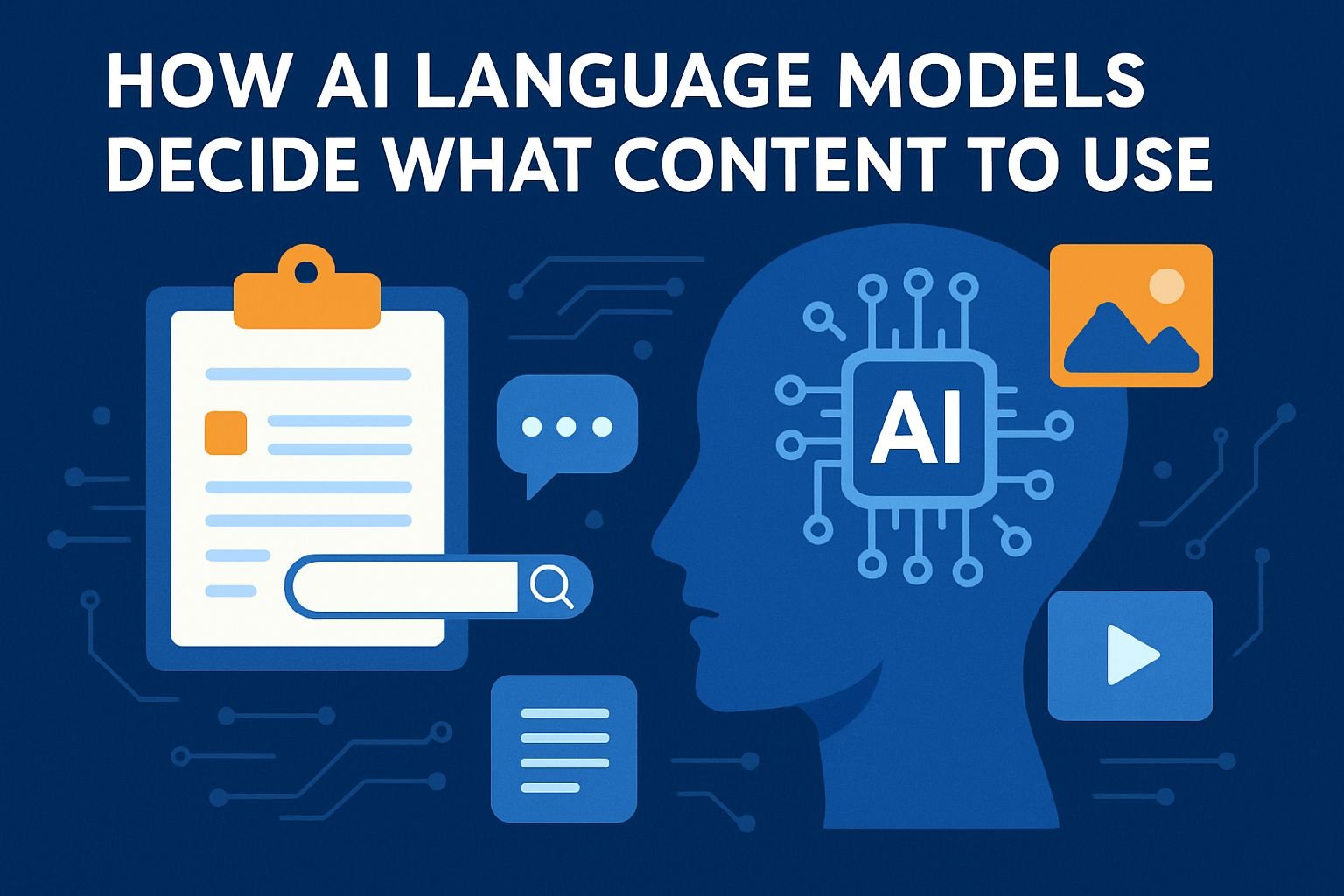
Knowing how AI models decide which sources to use can help us create content that is specifically designed for these systems. While each model has its own unique algorithm, there are some general rules that guide how content is selected and used.
What Makes AI Models Trust Your Brand?
AI language models take into account a wide range of signals when deciding which sources to cite. The main trust factors include the reputation of the source, the consistency of the information across multiple sources, the patterns of citation within respected publications, the recency of the data, and the factual accuracy. Content that appears on platforms with strict editorial standards typically gets higher trust scores, as does information that is consistent across multiple authoritative sources.
Trust evaluation is also affected by technical accuracy. If content has clear entity relationships, proper attribute labeling, and structured formatting, AI systems are more confident in their interpretation accuracy. These technical trust signals, in conjunction with traditional authority indicators, create a comprehensive trust profile that determines the likelihood of citation.
Content Formats That Get the Most AI Citations
Some content formats are more likely than others to get AI citations. Content that has a lot of data and a clear structure usually gets cited more often. Definitions that explain concepts in a simple and clear way also tend to get a lot of citations. Lists that organize information into clear categories also get a lot of AI citations.
Articles that use numbers, concrete examples, and comparisons are more likely to be quoted than general stories. This is because AI programs are better at checking and comparing specific facts than subjective statements. Formatting methods such as clear titles, organized tables, and diagrams showing connections between things greatly increase the chance of being quoted by making the information easier for AI to understand.
Why AI Models Might Overlook Your Content
It’s crucial to know why AI models might not pay attention to or downplay your content. The main red flags are not being consistent with other reliable sources, having outdated information, using too much promotional language, making unsupported claims, and using unclear wording. Content that seems to be mainly made to change rankings instead of providing value usually gets low trust scores. This is also true for information that goes against what is commonly known without enough evidence to back it up.
AI systems are often skeptical of problems like inconsistent formatting, broken structure, and unclear entity relationships. These technical issues are red flags that indicate potential reliability problems, causing AI models to look for other sources. Knowing these disqualifying factors can help avoid the typical errors that sabotage LLM seeding efforts.
7 Effective LLM Seeding Strategies for 2026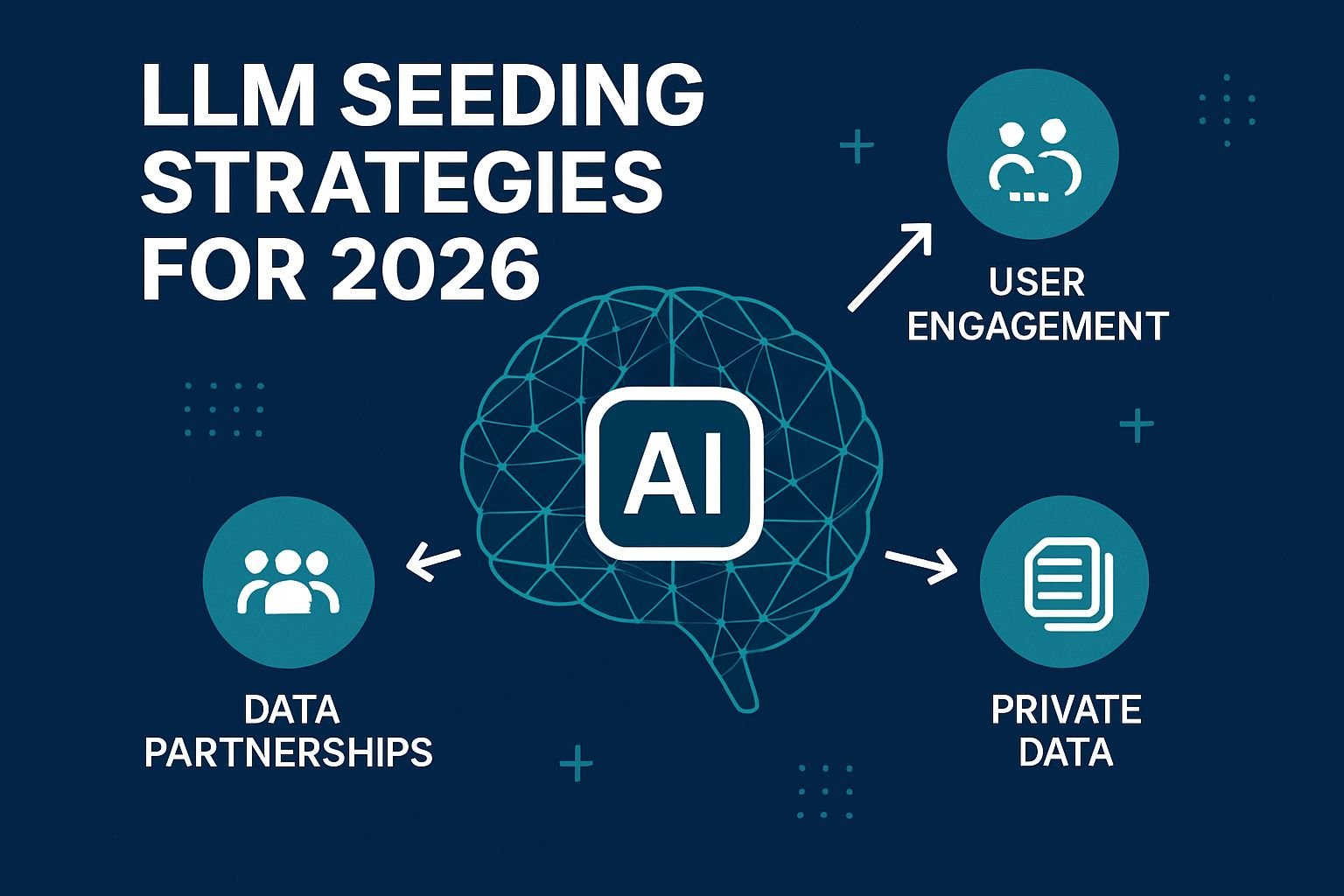
These seven strategies have been proven to yield excellent AI visibility results in a variety of industries and brand categories, and they can be applied practically.
1. Building Topic Clusters for AI Recognition
By building topic clusters, you can create a network of interconnected content that AI models can recognize as a comprehensive resource of knowledge. This method involves creating a pillar piece that covers a central topic in a broad manner, which is then supported by several related pieces of content that delve into specific aspects in more detail. The clear connections between these pieces of content aid AI systems in understanding relationships and recognizing the depth of expertise your brand possesses.
When you have a good set of topic clusters, you will have a clear path between related ideas, use the same terms consistently, and provide information that complements each other to form a complete knowledge structure. If AI models come across several pieces of your brand’s content that are linked to each other while they are being trained or retrieving information, they will be more likely to see your brand as an authority in that area and use your content to answer related questions.
2. Boosting Authority with Smart Partnerships
Smart partnerships with trusted authorities can give your AI visibility a big boost. When you create content in collaboration with recognized experts, research institutions, or industry organizations, you’re essentially borrowing their authority and making it more likely that you’ll be cited. These partnerships create a number of trust signals that AI models see as signs of credibility.
When your brand is featured in collaborative research projects, co-authored white papers, and joint industry reports, it sends a strong signal of authority. AI models will associate your content with a higher level of trust when it appears alongside established authorities. These strategic partnerships also broaden your distribution reach, placing your content in additional high-trust environments that AI systems often reference.
3. Content with Original Data that AI Models Love
AI models are most likely to cite content that is based on original data. This is because original research, surveys, or data analysis provide unique information that AI models find particularly valuable. If your brand is the primary source for certain data points, AI models will have no choice but to cite you when they reference that data.
Good data-driven content should explain the methodology used, visually represent the findings, and provide insights based on the data. Presenting this information in a structured format with the right attributions and technical accuracy can increase its chances of being cited. Data visualizations that clearly show relationships and trends are especially good at getting AI recognition and citation.
4. Content Formatting for Increased Citations
By formatting your content strategically, you can significantly increase the chances of AI systems citing it. This is because the right formatting makes your information easier for these systems to process. The kind of formatting that increases citation rates includes a clear hierarchical structure, clear labeling of entities, consistent use of terminology, and presenting data in a way that machines can read. These technical aspects reduce ambiguity and make AI systems more confident that they are interpreting and citing your content accurately.
5. Distribution on High-Trust Platforms
Being present on high-trust platforms strategically provides many ways for AI systems to find and verify your content. Each industry has specific platforms that are highly valued by AI models due to their editorial standards, verification processes, and overall authority.
Here’s a breakdown of the trust levels for priority distribution platforms:
Tier 1 (Highest Trust Level): Academic journals, government databases, industry standards bodies
Tier 2 (High Trust Level): Major industry publications, professional association resources, verified knowledge bases
Tier 3 (Medium-High Trust Level): Industry analyst reports, established media outlets, expert collaborative platforms
Tier 4 (Medium Trust Level): Company websites with established authority, industry forums with verification
By distributing the same information across multiple trust tiers, you create a reinforcing signal that significantly increases the likelihood of your brand being cited. When AI systems see the same information from your brand across multiple trusted sources, it creates a powerful verification effect that increases your chances of being cited.
Optimizing for each platform is crucial to fully leverage this distribution strategy. Every high-trust platform has unique content needs, formatting preferences, and verification processes that need to be meticulously addressed to ensure placement and optimize value transfer.
6. Schema Markup for AI Understanding
Putting in place detailed schema markup gives AI systems clear instructions on how to understand and categorize your content. This structured data method identifies entities, characteristics, and relationships in a standard format that minimizes uncertainty and boosts confidence in correct understanding. Schema markup essentially gives AI models an exact map of the meaning and context of your content.
Going beyond basic markup, advanced schema implementation involves entity relationships, attribute specifications, and contextual connections. This technical groundwork significantly enhances an AI system’s ability to accurately depict your content when producing responses. The specificity and clarity that proper schema markup provides give AI models more confidence in quoting your content, especially for technical or complex subjects.
7. Regularly Updating Content for AI
AI systems often prefer the most recent content, using the recency of the information as a key trust signal. By regularly updating your existing content with new information, examples, and data, you can ensure your information is always current and reflects the latest knowledge in your field. This is a more effective strategy than simply creating new content.
Updating your content regularly not only maintains your credibility but also shows that you’re an expert who stays current. When you update, make sure you keep the same URL, clearly show when the content was updated, and note any major changes. This balance of staying fresh and consistent is perfect for AI systems.
The best refresh cycles align with how quickly information changes in your industry. Industries where things change quickly will need more frequent updates, while evergreen content may need less frequent but more significant refreshes. Keeping an eye on how often your content is cited can help you figure out the best refresh intervals for different types of content and topics in your field.
How to Measure the Success of Your LLM Seeding
To determine the success of LLM seeding, you need to use different metrics than you would for traditional digital marketing. Instead of focusing on traffic and clicks as you would with conventional analytics, you need to use specialized tracking methods that capture how often your content is cited, the context in which it’s cited, and the impact it has. For a deeper understanding of these methods, check out this comprehensive guide on LLM seeding.
Effective evaluation merges the qualitative assessment of AI responses with the quantitative tracking of specific KPIs that point to increasing AI visibility. The aim is to form a clear connection between seeding activities and business results, thus creating a feedback loop that continually refines your strategy.
Consistently checking your seeding success across a variety of AI models gives the most comprehensive view of your performance. Each AI model has different thresholds for information, sources of training data, and patterns of citation that affect how often they mention your brand.
Key Measures Beyond Regular Analytics
The citation frequency is the frequency at which AI systems mention your brand while responding to relevant queries. This primary measure is a direct reflection of your AI visibility and should be monitored across various types of queries, AI platforms, and timeframes to spot trends and progress.
The way your brand is mentioned in AI responses is analyzed by citation context. This includes the position (whether it’s mentioned early or late in the response), sentiment (whether it’s positive, neutral, or negative), and association with certain attributes or capabilities. Context provides more detailed insights than just raw frequency counts, showing how AI systems perceive and depict your brand.
By comparing yourself to your competitors, you can see how often you’re mentioned in similar searches. This comparison can help you see where you’re falling short and where you can improve. It’s also a great way to understand your own metrics.
Tracking AI Citations and Brand Mentions: A Toolkit
Top Tools for Tracking AI Citations in 2025
AIWatcher: All-in-one citation tracking across major AI platforms, complete with sentiment analysis
BrandIntel AI: A tool for comparing citation frequency and context against competitors
CitationMetrics: Automated query testing and citation logging, with trend analysis thrown in
AIVisibility: Real-time alerts for new brand mentions in AI responses
ResponseAnalyzer: Semantic analysis of citation context and attribute association
These tools are designed to automate the monitoring of AI responses across different platforms, tracking when and how your brand is mentioned in AI-generated content. Most of these tools provide a dashboard that visualizes citation trends, competitive comparisons, and context analysis, helping you identify patterns and opportunities.
Even with automated tools, manual testing is still crucial as it provides a more in-depth qualitative evaluation of how AI systems embody your brand. Regular testing with different query formats can help spot subtle patterns that automated tools may overlook, especially when it comes to nuanced context and positioning.
It’s important to test across different platforms because AI models can vary greatly. If your brand is often mentioned in one AI system but barely seen in another, this could mean you have chances to optimize for specific platforms.
Expectations for LLM Seeding Timelines
Usually, you can start seeing the fruits of LLM seeding between 60-90 days. However, the exact timeline can be influenced by factors such as the competitiveness of the industry, the current digital footprint, and the scope of the implementation. The first signs of progress are typically seen in specialized or long-tail queries where there is less competition. Meanwhile, it may take longer to see improvements in broader competitive terms.
Building a strong AI visibility typically takes about 6-12 months of regular execution, with the frequency and context of your citations improving as your seeding strategy develops. It’s important to be patient and persistent because the regular practice of seeding results in increasing returns over time.
It’s important to set realistic expectations that are appropriate for the stage you’re at to keep everyone in the organization committed during the initial building phase. In the beginning, the success metrics should be more about how often citations appear and less about the impact on the business. As your AI visibility grows and reaches a critical mass, that’s when ROI metrics start to become more relevant.
Case Study: How Three Brands Took Over AI Recommendations
There’s no better way to understand the power of LLM seeding than seeing it in action. These three case studies show how brands from various industries managed to gain impressive AI visibility and business outcomes by using smart seeding strategies.
B2B Software Company: From Nowhere to be Found to a 73% Citation Rate
A medium-sized project management software company was nowhere to be found in AI recommendations, even though it had a strong SEO performance. Their initial testing showed that when users asked about the “best project management software,” their brand was never mentioned in AI responses, even though it was in the top three on Google.
They concentrated their LLM seeding efforts on developing extensive comparative information, releasing integration manuals on partner sites, and creating structured product descriptions using standardized schema. In just four months, they achieved a 73% citation rate for category-specific searches, resulting in a 42% rise in demo inquiries from prospects who cited “AI recommendation” as their source of discovery.
How a Home Goods Retailer Tripled Conversions Using AI Visibility
A retailer of handcrafted home goods used LLM seeding to fight against decreasing visibility as customers started using AI shopping assistants. Their strategy focused on standardizing detailed product attributes, being transparent about where they source materials, and strategically placing product comparisons on review platforms that customers trust.
The brand was mentioned in 68% of product category searches within half a year, with a particular emphasis on sustainability and quality-related inquiries. This level of AI visibility resulted in conversion rates that were 3.2 times higher than their traditional marketing channels, with customers indicating a higher level of confidence in their purchases due to AI recommendations.
How a Local Service Business Used AI to Beat National Competitors
An HVAC service provider in a particular region managed to outperform national chains that had much larger marketing budgets by using LLM seeding. They accomplished this by focusing on local knowledge and creating detailed content that addressed specific problems and solutions, offering clear pricing structures, and systematically gathering data related to their services from their market area.
In just five months, they managed to score an 81% citation rate for location-specific service queries. This is despite the fact that they were up against national chains in their service area and only had less than 20% of the marketing budget of their larger rivals. They saw a 47% increase in the volume of appointment bookings, and 38% of new customers said they came because of recommendations from the AI assistant.
Typical LLM Seeding Errors That Can Drain Your Wallet
Recognizing typical blunders can prevent expensive errors that hinder AI visibility initiatives. These often-seen mistakes can dramatically lessen the success of LLM seeding investments.
Quality Over Quantity
The most common mistake is focusing on the number of content pieces rather than the quality of the content. AI systems value quality and authority over quantity. Publishing a large amount of shallow content across multiple platforms usually doesn’t work well. AI models are increasingly focusing on depth, specificity, and factual density. Successful seeding requires fewer, more comprehensive resources with stronger authority signals rather than high-volume, shallow content distribution. For more insights on this, you can explore https://llmseeding.io/ai-citations-vs-backlinks/LLM SEEDING™ Network take on LLM seeding.
Factors that have a real impact on AI citations include accuracy of facts, in-depth coverage, clear organization, and regular cross-referencing within knowledge areas. These aspects produce the authority signals that cause AI systems to cite your content when answering related questions.
Overlooking Content Structure and Format
Countless organizations are producing meaningful content, but not structuring it in a manner that allows AI to understand and cite it. Unstructured narrative text, while useful for humans, is problematic for AI systems that need to pull out specific information for citations. Without distinct entity relationships, attribute labeling, and structured formatting, even highly authoritative content can be missed when AI models are creating responses.
Not Meeting the Verification Standards
AI systems are more and more focusing on information that they can confirm from several sources. Content that is standalone, without supporting references from other credible sources, gets lower trust scores no matter how good it is in itself. Seeding that works requires making verification routes that let AI models check your information from several credible sources.
There are several ways to verify your information, including making sure the information is consistent across your owned properties, getting validation from a strategic third party, and aligning with established knowledge sources that AI systems trust. This will greatly increase your chances of being cited, especially for product claims, statistical data, and comparative assertions.
One Size Doesn’t Fit All
Each AI language model is unique, with its own training methods, knowledge bases, and citation tendencies. To treat them all the same is to overlook these important distinctions, which can lead to missed opportunities for citation across the AI landscape. Every major AI platform has its own preferred types of content, signs of trustworthiness, and verification needs, all of which play a role in determining whether or not a piece of content gets cited.
Looking Ahead: AI Visibility and What to Expect Post-2026
AI Visibility Trends Worth Watching
Multi-Modal Citation: AI systems that cite visual and audio content, as well as text
Real-Time Knowledge Integration: Quicker integration of new information into AI responses
Verification Ecosystems: Growing focus on cross-source verification before citation
Domain-Specific Authority: More refined recognition of specialized expertise
User-Context Adaptation: Citations that are tailored to individual user contexts and preferences
AI visibility is a rapidly changing landscape, with several emerging trends already redefining how brands should approach LLM seeding. By understanding these future directions, you can create strategies that will remain effective as AI systems continue to evolve.
There’s a growing focus on verification that will probably necessitate enhanced cross-platform uniformity and third-party authentication. AI systems are becoming more rigorous about fact-checking before referencing information, particularly when it comes to efficacy, comparison, or statistical significance claims.
The most significant change on the horizon is the integration of multi-modal content. AI systems are quickly gaining the ability to process and reference information from images, videos, audio, and interactive content in addition to traditional text. Brands that prepare multi-modal content with the right structure and metadata will have an edge as these capabilities become more important.
Upcoming Changes in AI Reference Styles
Reference Style Progression
2023-2024: Mainly text-based references from reputable sources
2025-2026: Incorporation of multi-modal content and live data
2027-2028: Proactive references based on expected user queries
Post 2028: Dynamic content production using brand-approved guidelines
Reference styles are becoming more advanced, with AI systems learning more refined methods for choosing sources and giving credit. Early AI models heavily depended on popularity signals like traditional search engines, but newer systems use more intricate assessments that take into account subject matter expertise, information detail, and verification methods.
The idea of user-context adaptation is becoming more important in decisions about citations. This means that AI systems are more often taking into account individual user preferences, past interactions, and specific needs when they choose sources to cite. This personalization can present both challenges and opportunities for brands that want to be cited consistently across diverse user segments. For more insights, explore LLM Seeding and its impact on AI-driven personalization.
The speed at which information is integrated in real time is increasing, with the delay between the publication of information and its availability for AI citation decreasing. This trend benefits brands that consistently maintain fresh content strategies, while posing challenges for crisis management when negative information emerges.
Getting Ready for Multi-Modal AI Referencing
As AI systems become more advanced in processing images, video, audio, and interactive content, multi-modal seeding strategies are becoming a necessity. This broader approach requires the creation of consistent brand information across multiple content formats, with the right structure and metadata to help AI understand and cite it.
Establishing a Brand Foundation for AI Now
What you do now will set the stage for your brand’s AI visibility in the future. By creating a well-structured, thorough content resource with strong verification signals, you are setting yourself up for success as AI systems continue to grow and become more influential in the market.
How to Launch Your LLM Seeding Strategy in 30 Days
Getting your LLM seeding strategy off the ground isn’t about cobbling together a bunch of tactics. It’s about having a system. This 30-day launch plan is a step-by-step guide for businesses that are just starting to use AI to increase their visibility. It tells you exactly what you need to do and when you need to do it.
The strategy adheres to a tried-and-true sequence that establishes basics before expanding efforts, guaranteeing effective resource distribution and quantifiable advancement. Each stage tackles particular elements of the three fundamental columns: content credibility, tactical dissemination, and structured data application.
You can adjust this model to fit your industry’s particularities, your existing digital assets, and your competition. Companies with pre-existing content resources may be able to speed up certain stages, while those starting with little may need to stretch the timeline to get better results.
- Conduct a comprehensive AI visibility audit across major platforms
- Benchmark current citation rates for brand and key products/services
- Identify high-priority content gaps and distribution opportunities
- Develop structured measurement protocols and success metrics
- Create platform-specific optimization guidelines
Week 1: Audit and Strategy Development
Begin with a thorough assessment of your current AI visibility, testing various query types across multiple AI platforms to establish baseline citation metrics. Compare your performance against key competitors to identify specific gaps and opportunities. This audit should evaluate both citation frequency and context, noting how AI systems currently represent your brand when it does appear in responses.
With the insights you gain from your audit, you can create a strategy that prioritizes your biggest visibility issues and takes advantage of your current strengths. You should also establish clear success metrics and set goals for 30, 90, and 180 days. It’s also important to set up testing protocols to ensure that you’re measuring your progress consistently throughout the implementation process.
Week 2: Tweaking Content and Sharing It
Concentrate on adjusting your most promising existing content so that AI can understand and refer to it. Use the right structure, schema markup, and formatting to make this content easier for AI systems to handle. At the same time, start sharing it strategically on high-trust platforms that are relevant to your field, making sure the information is the same on all channels.
Week 3: Observation and Fine-Tuning
Start a regular check-up of citation metrics across your chosen query categories and AI platforms. Use the initial results to see which content elements and distribution channels are giving you the best citation improvements. Fine-tune your approach based on these insights, focusing more on effective tactics while tweaking those that are not performing well. For more insights, consider exploring LLM Seeding strategies to enhance your citation metrics.
Week 4: Expansion and Automation
- Build repeatable methods for continuous content enhancement
- Design distribution patterns for uniform multi-platform presence
- Introduce automated citation monitoring across essential AI platforms
- Set up regular testing and refinement cycles
- Record best practices specific to your brand and sector
With established proven foundations, concentrate on creating scalable systems that preserve consistent LLM seeding activities. Develop standard operating procedures for content creation, enhancement, and distribution that incorporate effective AI visibility elements. Introduce automation where suitable to increase efficiency while maintaining quality standards.
Put in place continuous measurement systems that monitor progress against your set metrics, with regular reporting that links AI visibility enhancements to business results. This responsibility generates organizational support for ongoing investment in LLM seeding activities.
Take the time every 90 days to thoroughly evaluate your results and adjust your plan based on the data you’ve collected. This key review should look at how often you’re mentioned in different types of searches, on different platforms, and compared to your competitors to find new opportunities for the next stage.
Don’t forget that LLM seeding isn’t a one-off task, but a continuous process that needs constant care and improvement. The most successful companies have dedicated resources and clear responsibilities to ensure AI visibility is a key marketing function.
Common Questions
When businesses start using LLM seeding methods, they often have several questions. They want to know about how long it will take, how it will affect competition, and how it will fit in with their current marketing strategies. These are important things to think about so you know what to expect and how to use your resources.
When can I expect to see results from LLM seeding?
You will usually start to see initial results within 60-90 days, with specialized or long-tail queries showing improvements first. Competitive head terms often require 6+ months of consistent implementation before significant citation improvements appear. The timeline varies based on your existing digital footprint, industry competitiveness, and implementation scope.
The most dependable early signs come from keeping an eye on particular test searches that are directly linked to your optimization focus areas. These guardian searches give insight into how AI systems are handling your content before wider citation patterns appear across general category terms.
Is it possible for small businesses to compete with big brands in terms of AI visibility?
Despite having fewer resources, small businesses can still achieve great success in AI visibility. AI systems tend to prioritize the quality of information, depth of expertise, and specificity over the size of the brand or marketing budget. Strategies that are focused and address specific niches or specialized use cases often do better than the broader approaches used by bigger competitors, especially in categories that are highly specialized or relevant locally.
Should I ditch traditional SEO for LLM seeding?
LLM seeding isn’t a replacement for traditional SEO, but rather a complement to it. The most successful online presence will incorporate both, optimizing for both search engine visibility and AI citations. Many of the basic elements of high-quality content are beneficial to both channels, although the specific technical implementation differs between the two.
Companies often find the most success by sticking to their fundamental SEO strategies and incorporating elements of LLM seeding to improve visibility in AI. This comprehensive strategy ensures visibility in all the ways customers find information, from traditional search to AI-driven discovery.
What is the cost of a thorough LLM seeding strategy?
The cost of implementing a strategy can vary greatly depending on your current content resources, the complexity of your industry, and the competitiveness of your market. Organizations that already have a solid foundation of content may need to invest mainly in optimization and distribution, while those starting with little to no foundation will need to invest more heavily in developing content.
It’s common for medium-sized businesses to dedicate 15-25% of their digital marketing funds to LLM seeding efforts. This percentage often grows as the return on investment becomes evident through measurable results. The most affordable method typically includes incorporating LLM seeding components into current content procedures rather than considering it as a completely distinct project.
Typically, you’ll start to see a return on your investment within 4 to 6 months as your citation improvements increase your brand’s visibility and attract more potential customers. If you implement comprehensive tracking, you’ll often be able to trace specific revenue back to the customer acquisition recommended by AI.
Will AI platforms start charging for brand mentions?
There are signs in the industry that a hybrid model is developing where organic mentions will continue based on relevance and authority, but paid placements will also be an option. The basic usefulness of AI assistants relies on providing accurate and helpful information, which creates a strong motivation to keep organic mention methods that are based on real relevance and not just paid placements.
The future of AI visibility marketing will probably look a lot like the evolution of search engines. Organic visibility will continue to be the most important factor, but there will also be opportunities for paid visibility. Companies that build strong organic citation patterns now will be in a good position to take advantage of these opportunities as they become available.
No matter how the ways we make money change, putting resources into thorough, well-organized content with obvious signs of authority is always valuable across many channels. These basic elements improve performance across all digital platforms and build a specific advantage in AI visibility.
Want to improve your brand’s visibility in the AI-driven marketplace? In-depth LLM Seeding resources are available to help you execute these strategies and ensure steady AI citations across major platforms.