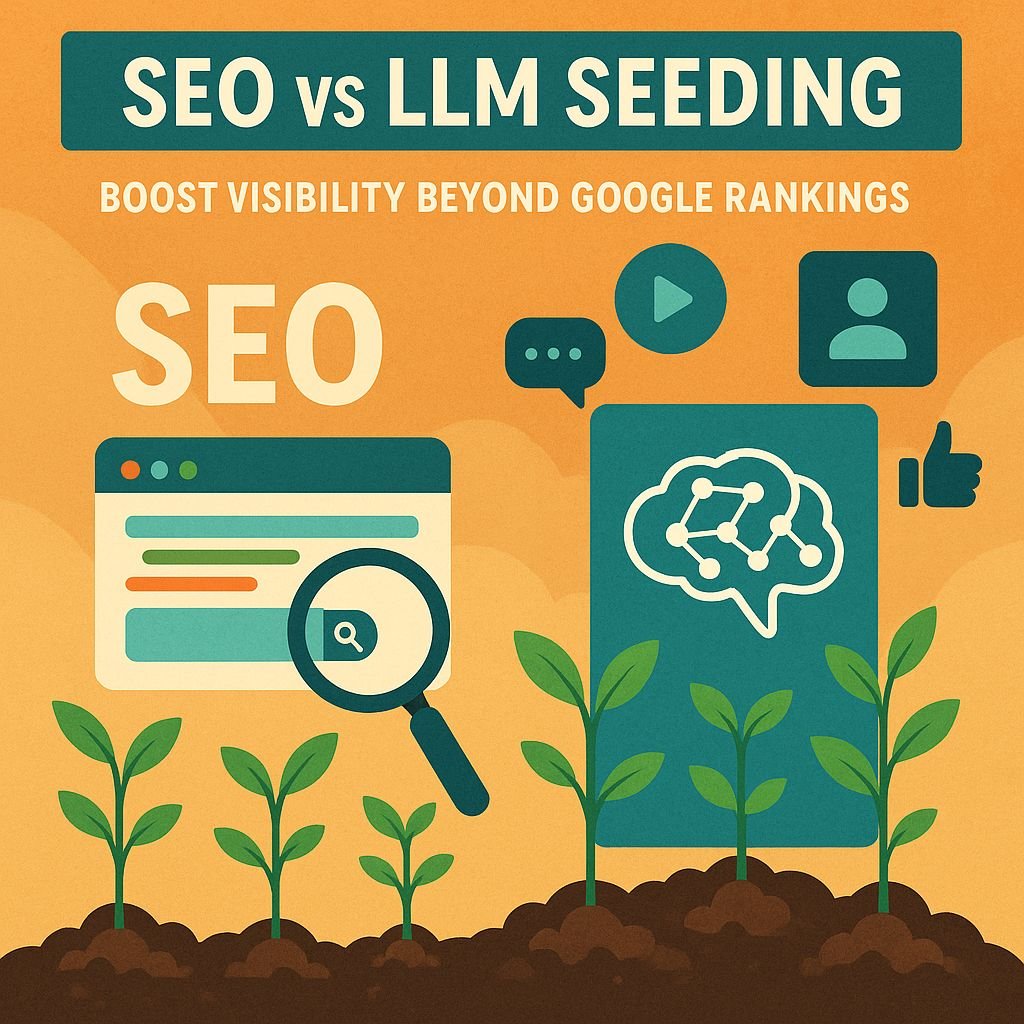
In a Nutshell
- LLM seeding is an innovative way to gain visibility in AI-generated responses, which is a great addition to traditional SEO efforts
- While SEO is focused on clicks, LLM seeding is focused on citations in AI tools like ChatGPT and Gemini
- Content that is optimized for LLM seeding uses specific formats and structure that AI models can easily parse and reference
- Backlinko’s approach to digital visibility combines both strategies for maximum reach in changing search landscapes
- Companies that implement LLM seeding now will establish authority before competitors, creating a significant competitive advantage
The game of digital visibility has fundamentally changed. The days when ranking at the top of Google was enough to ensure your content gets seen are over. Today’s fragmented attention landscape demands more than just SEO expertise—it requires strategic positioning across the entire digital ecosystem, especially within the growing realm of AI-generated content.
As AI search tools change the way people access information, savvy marketers are incorporating LLM seeding into their visibility strategies. Research from Backlinko suggests that this method helps brands stay visible even when users don’t click through search results, establishing authority directly within AI responses.
The Modern Struggle for Online Visibility: Why It’s Not Just About Rankings Anymore
Search is changing at a pace that many marketers are struggling to keep up with. The advent of AI search tools from the likes of Google, Microsoft, and independent companies such as Perplexity has opened up a whole new front in the battle for visibility. These tools don’t just link to content – they absorb it, condense it, and reference it directly in their answers.
Nowadays, almost 65% of Google searches are zero-click, meaning they end without a click to another web page. Plus, more and more people are using voice assistants and AI tools that give direct answers. So, it’s becoming more and more important for your content to be seen beyond just the traditional search rankings.
Brands must adjust their visibility strategies to this change or risk disappearing from the view of an increasing number of information seekers. Getting mentioned and referenced by AI tools is becoming as critical as appearing in search results. In many instances, it’s the only way your brand will get noticed.
Understanding LLM Seeding and Its Current Importance
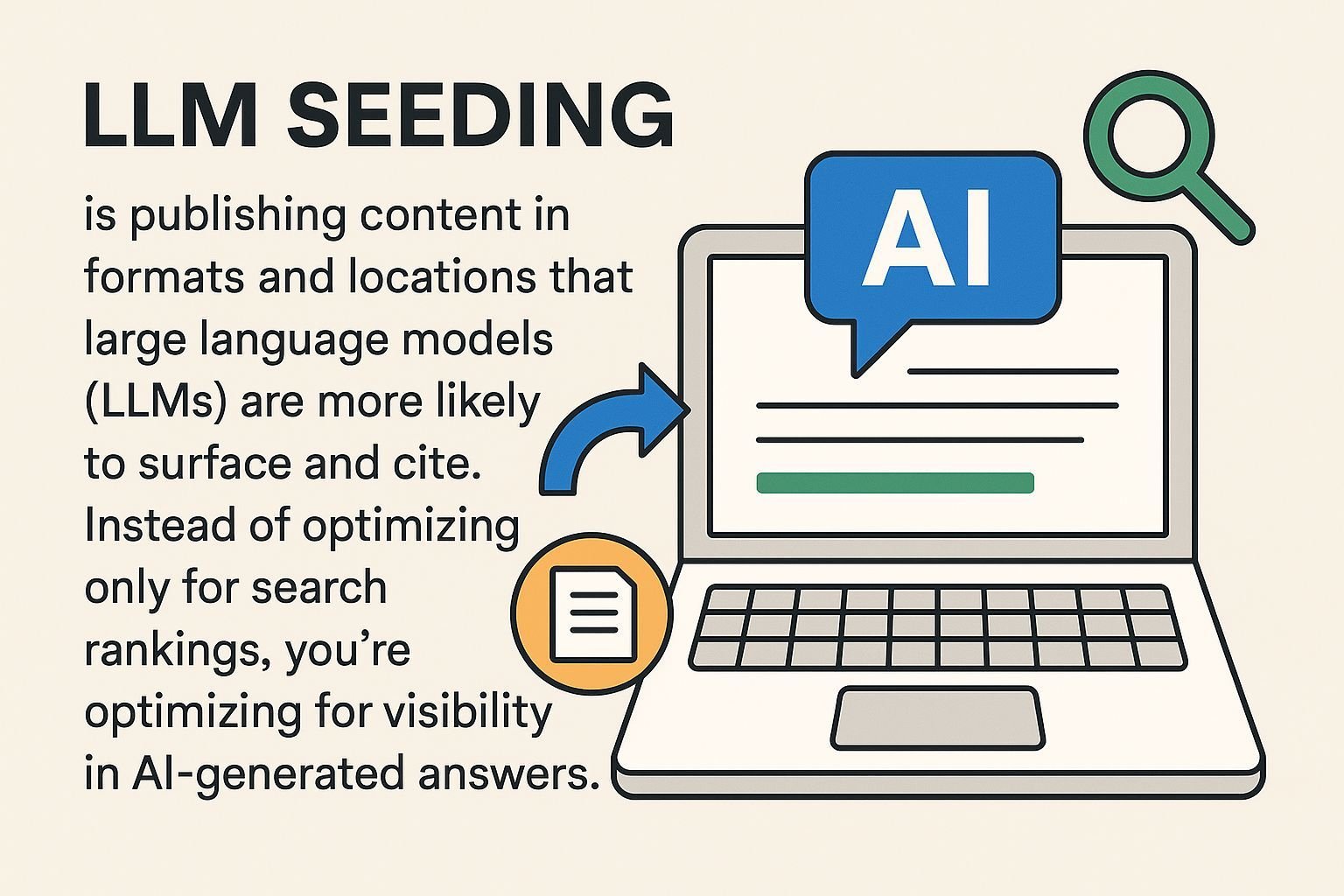
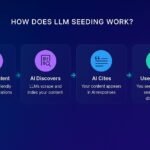
LLM seeding refers to the tactical method of disseminating content in formats and locations that large language models (LLMs) are most apt to crawl, comprehend, and reference in their responses. Unlike conventional SEO, which concentrates on acquiring clicks via search rankings, LLM seeding seeks to have your content directly quoted within AI-generated answers—even if no one clicks through to your site.
As AI tools like ChatGPT, Gemini, and Perplexity continue to evolve, they’re increasingly becoming the go-to resource for information. Users ask a question and often accept the answer given without feeling the need to visit the source website. If your brand isn’t mentioned in these AI responses, you’re missing out on key visibility opportunities in this ever-changing search landscape.
What is LLM Seeding?
LLM seeding is a strategy to make your content easily found, understood, and referenced by AI systems. It’s all about creating information that AI models can easily read, understand, and see as authoritative enough to reference in their responses to user queries.
LLM seeding is not like your usual content marketing. It values clean semantic structure, accurate facts, and broad distribution on reliable platforms. The aim is not necessarily to bring in direct traffic, but to make sure your brand and expertise are included in AI-generated content that users consume directly.
How ChatGPT and Gemini, AI Tools, Gather Information
When it comes to gathering information, AI tools work in a different way than your typical search engines. Instead of ranking pages by links and keywords, these systems process a lot of text to understand relationships, concepts, and factual information. When they generate responses, they pull from this knowledge base, citing sources that they believe are reliable, comprehensive, and relevant.
A Paradigm Shift: From Clicks to Citations
AI search signals a critical shift in the way we gauge digital success. For more than twenty years, clicks have been the main metric of digital visibility—fueling everything from ad expenditure to content development. Today, we’re seeing a paradigm shift toward citations as a crucial performance indicator.
When an AI system refers to your content, you gain visibility without needing a user to interact with your website. This exposure through citation creates brand awareness, sets up authority, and drives recognition that can later convert into direct engagement. The most progressive marketers are already adjusting their strategies to take advantage of this change, realizing that future digital visibility will depend as much on AI references as on search rankings.
Comparing Traditional SEO and LLM Seeding
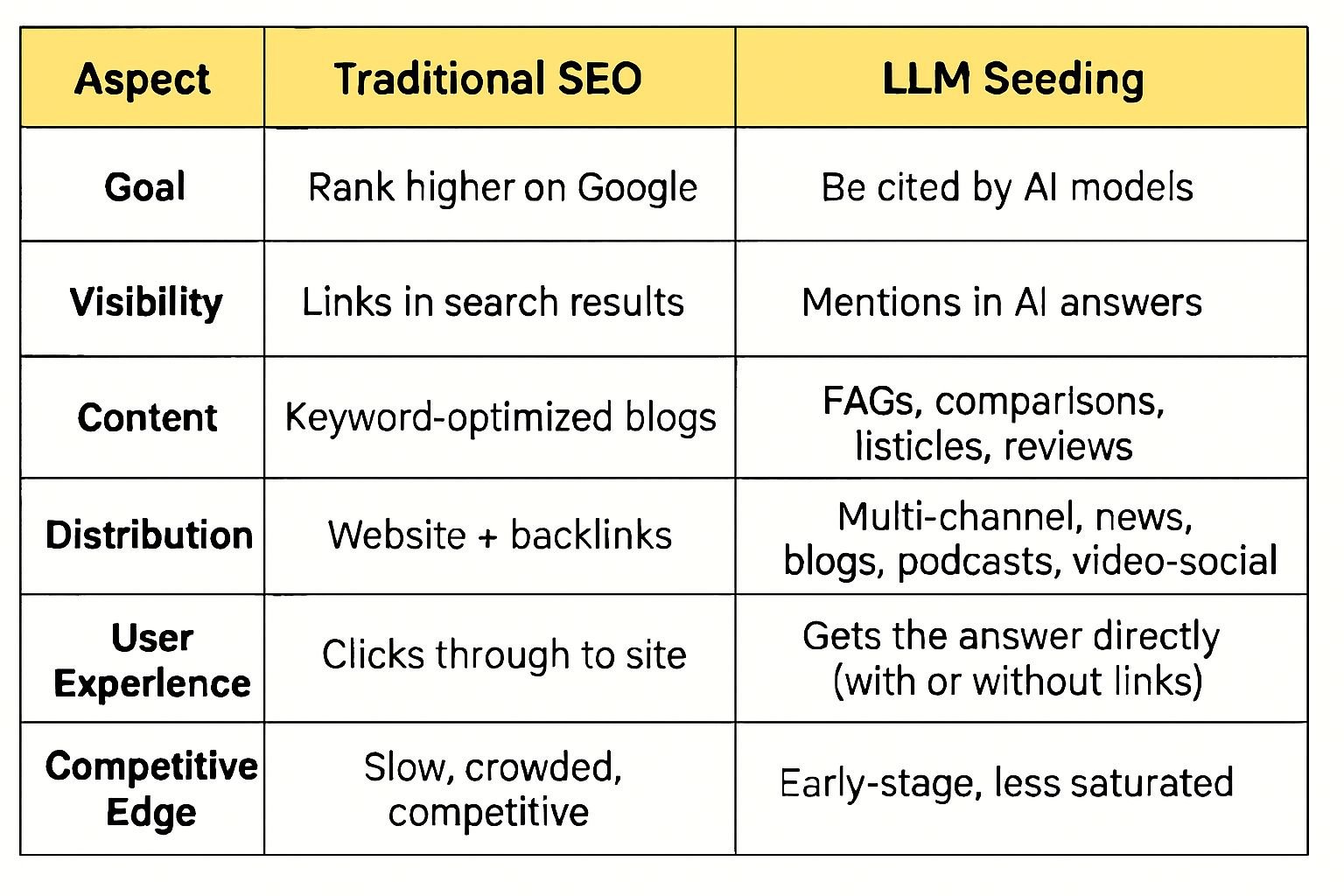
Though SEO and LLM seeding share a common goal of increasing visibility, they do so using very different methods. SEO is all about attracting website traffic through search rankings by focusing on keywords, backlinks, and technical optimization. LLM seeding, on the other hand, is more concerned with getting your content quoted in AI-generated responses. This requires clear structure, accurate information, and distribution across several trusted platforms.
While the success of traditional SEO is gauged through rankings, click-through rates, and traffic metrics, LLM seeding success is measured through citation frequency, brand mention accuracy, and visibility within AI responses. These different objectives necessitate unique approaches to creating and distributing content.
One of the most significant distinctions is that SEO usually focuses on your website, while successful LLM seeding goes beyond your domain to third-party platforms that AI models regularly crawl and trust. This larger footprint makes it more likely that AI systems will find, process, and eventually reference your content.
Prioritizing Site Visits vs. Prioritizing Brand Exposure
Historically, SEO has focused on numbers like organic traffic, sessions, and page views. The goal is to get people to your website, where you can control the user experience, capture leads, or make sales. This strategy has been effective for many years, but it’s becoming increasingly outdated in the modern search environment.
LLM seeding changes the game by emphasizing brand visibility and the frequency of citations over the acquisition of traffic. The idea of success is not how many people visit your site, but how often your brand is mentioned in AI-generated responses. This strategy understands that even if users never click on your content, they still see your brand being mentioned as an authority, which is a valuable exposure for your brand.
Therefore, your content strategy must balance two objectives: creating content that ranks well in search engines and crafting formats and structures that AI systems can easily reference. Companies that successfully manage this dual approach will achieve the highest visibility across both traditional and emerging search channels.
SEO Ranking vs. Link Building Metrics
Most people measure the success of SEO by looking at keyword rankings, the growth of organic traffic, and how visible they are in search engine results pages (SERPs). This usually means optimizing content to appear at the top of search results, using rank tracking tools to measure performance, and celebrating when there are improvements in position. While these metrics are still important, they don’t provide a complete picture of digital visibility.
LLM seeding shifts the focus to new performance metrics: the frequency of citations, the precision of brand mentions, and the presence in AI-created content. Instead of keeping tabs on how many users click on your links, you keep track of how often AI systems cite your content as a reference. This calls for different ways of measuring, such as testing prompts, monitoring your brand across AI tools, and studying citation trends.
Creating Links vs. Establishing Authority
With conventional SEO, creating links is the foundation of domain authority. You put a lot of resources into getting backlinks from relevant, high-authority websites to show search engines that you’re credible. While this is still useful for search rankings, it’s only part of the authority equation in the world of LLM.
LLM seeding is all about building a broader sense of authority that goes beyond just backlinks. AI systems evaluate authority based on the completeness of the content, the accuracy of the facts, structured data, and presence across trusted platforms. The goal is no longer just to accumulate links, but to establish your content as the most reliable, well-structured source of information on your topic, no matter where that content is located.
The Zero-Click Phenomenon: The Limitations of SEO
The search landscape has been transformed by the advent of featured snippets, knowledge panels, and AI-generated responses. Research indicates that over 65% of Google searches now conclude without a click to a website – users find the answers they need directly in the search results. This “zero-click” phenomenon implies that brands that depend exclusively on website traffic are overlooking significant visibility opportunities.
LLM seeding bridges this gap by making sure your brand is included in these direct answers. Instead of combating the zero-click trend, you can use it to your advantage by positioning your content to be referenced within the features that eliminate the need for clicking. This adaptation acknowledges that brand visibility now goes beyond website traffic to include appearances in AI-generated content that users consume without ever visiting source sites.
5 Reasons Why LLM Seeding Should Be Part of Your Plan
By using LLM seeding in combination with standard SEO, you can create a complete visibility strategy that functions throughout the whole digital ecosystem. This two-pronged approach makes sure your content gets to users no matter how they choose to get their information—whether it’s through direct search, AI tools, or voice assistants.
1. Engage with Users Who Don’t Click Through Search Engine Results
There’s a rising number of zero-click searches, and these users represent a large audience that traditional SEO can’t engage with. These users get the information they need from features in the search results or answers generated by AI, and they don’t visit the websites that are the source of the information. By using LLM seeding, you can make sure your brand is included in these direct answers, so you’re still visible even if users don’t click through to your website.
Having a wider reach is especially beneficial for content in the awareness stage and for building your brand. Even if users don’t click, citing your brand as a reliable source creates awareness that can impact future choices. It’s like having free brand advertising directly in the content users read.
2. Establish Your Brand’s Credibility in AI-Produced Answers
As AI applications keep referring to your content, it sends a strong credibility signal to users and the AI algorithms. Users start to see your brand as a subject matter expert, and AI models might give more importance to your content in their future answers. This results in a positive feedback loop of growing credibility and visibility.
Even among those who might never have stumbled upon your brand through traditional search, this authority building occurs. Your expertise is exposed to new audiences as AI tools quote you in response to inquiries you might never have directly targeted through SEO. This expanded reach accelerates brand recognition across a variety of audience segments.
3. Guarding Against Decreasing Click Rates
Search habits are constantly changing, moving away from the old “search > click > read” pattern that has been the norm for many years. As AI becomes more and more integrated into search, it’s likely that click-through rates will keep going down in many industries. Brands that make changes now will be able to stay visible, no matter how search interfaces change in the future.
It’s especially important to future-proof your content with the ongoing advancements in direct answer capabilities by Google, Microsoft, and independent AI search tools. By making your content citation-worthy now, you’ll ensure that it remains visible as these systems continue to develop and capture a larger share of the search market.
4. Increase Your Visibility in Voice Search and AI Assistants
When you conduct a voice search through a smart speaker, phone, or AI assistant, you’ll typically only get a single answer instead of a list of results. Because of this winner-takes-all format, traditional SEO ranking strategies that aim for “page one” aren’t enough. You need to be THE source that gets cited in the response.
LLM seeding is a technique that makes your content the primary source that voice assistants and AI tools use to answer questions. This is especially beneficial for local businesses, FAQ content, and direct questions where dominance in voice search provides exclusive visibility.
These interactions are often conversational in nature, which means users often hear your brand mentioned directly, for example, “According to [Your Brand], the best approach is…” This verbal citation creates stronger brand recognition than typical search results where your brand might be just one of many options.
- Voice search usage continues growing, with over 40% of adults using voice search daily
- Most voice searches return single answers rather than multiple options
- AI assistants draw from the same LLM technology that powers tools like ChatGPT
- Structured data and clear semantic content improves voice search performance
5. Diversify Your Digital Presence Beyond Google
Over-reliance on Google traffic creates significant business risk as search behaviors diversify across platforms. By implementing LLM seeding across multiple AI tools and platforms, you create redundancy in your visibility strategy that insulates you from algorithm changes or shifts in any single platform’s popularity.
How to Craft Content That Appeals to LLMs
Designing content for LLM seeding necessitates a different strategy than conventional SEO content. While SEO usually emphasizes keyword frequency, word count, and engagement metrics, content that is friendly to LLMs prioritizes a clear structure, factual accuracy, and a thorough presentation of information.
Fortunately, well-structured, informative content typically does well for both SEO and LLM seeding. The main differences are in formatting, how information is organized, and distribution strategy, not in the basic quality of the content itself.
- Concentrate on sharing clear, accurate information in a structured way
- Arrange your content in a way that clearly shows the relationship between different ideas
- Make sure to thoroughly cover any subtopics related to your main subject
- Share information in a way that’s easy for machines to understand
Keep in mind that AI models are primarily looking for content that they can confidently cite as accurate and authoritative. This means clarity and factual precision often matter more than creative writing or brand voice—though well-written content that balances both performs best overall.
Understanding Semantic Structure: Headers, Lists, and Tables
LLMs are significantly dependent on the structure of the content to comprehend the connection between information. Clear, hierarchical headers (H1, H2, H3) are used to signal the organization of the topic, while properly formatted lists and tables present information in a way that is easily parsed. This structured approach aids AI systems in understanding which information belongs together and how concepts are related to each other.
LLM seeding really shines when it comes to tables because they neatly arrange related data in a way that machines can easily comprehend. Employ tables for comparison data, feature listings, and statistical information to up the odds that your content will be referenced when users pose related queries.
Analyzing How Often You’re Cited
It’s important to keep track of how often your brand and content are mentioned across various AI tools to understand how effective your LLM seeding is. You should set up a regular schedule for testing. During these tests, you should ask multiple AI tools questions that are relevant to your industry and see if your brand is mentioned in the responses. Pay attention to how often you’re cited across different topics. This will help you identify where you have strong visibility and where there are gaps. You can use this data to improve your content strategy and increase your citation frequency in areas where it’s currently low.
Referral Traffic from AI Tools
Even if no one clicks on them, direct citations are still valuable. Some AI tools include source links that drive referral traffic. In your analytics platform, create segments specifically for traffic from AI tools and platforms like Perplexity, Bing Chat, and others that link to sources. This traffic represents users who found your citation compelling enough to explore further, making it particularly high-value.
When you’re looking at this traffic, focus on engagement metrics. Visitors from AI tools often come with specific information needs that are already partially met, so they browse differently than traditional search visitors. If you see lower bounce rates and higher conversion rates on this traffic segment, it means your content is successfully adding to the value provided in the AI-generated answer.
Where SEO and LLM Seeding Converge: Crafting a Balanced Approach
- Pinpoint topics that can be optimized for both search visibility and AI citations
- Develop base content that can be tweaked slightly to cater to both strategies
- Strategically spread content across owned and third-party platforms
- Take a holistic approach to measuring performance, considering both traditional metrics and citation frequency
- Allocate resources based on where visibility offers the most business value
Successful digital visibility strategies don’t pit SEO and LLM seeding against each other. Instead, they incorporate both into a cohesive content strategy that optimizes visibility across all platforms where potential customers might be looking for information. This comprehensive approach acknowledges that different audience segments have different preferences when it comes to finding information, and that full visibility requires meeting users where they are.
Begin with a visibility audit that looks at both your traditional search performance and your citation presence in AI tools. Find areas where you’re visible in one channel but not in another, which gives you the chance to increase your reach without starting over. Often, you can reformat or redistribute existing high-performing SEO content to increase your LLM citation rates without having to invest much more.
It’s crucial to keep in mind that these strategies often complement each other. Content that performs well in search usually contains the thorough information and clear structure that LLMs also find appealing. Similarly, the broader distribution needed for effective LLM seeding can create backlinks and social signals that enhance SEO performance. Look for these synergies when planning your integrated strategy.
Planning Content for Double the Optimization
When you’re planning your content, think about how you can make each piece work for both visibility channels with as few changes as possible. Begin with thorough research that finds both search keywords and common AI queries related to your topic. Organize your content with clear headers, factual statements, and structured information that’s easy for both humans and machines to understand. To get the most out of your efforts, create a main piece of content that’s optimized for SEO, then create variations that are formatted specifically for LLM seeding on third-party platforms.
Focus on the kinds of content that do well in both strategies. Detailed guides, comparison pieces, listicles based on facts, and well-organized FAQs often do well in both traditional search and LLM citations. Make these formats a priority in your content calendar to get the most out of your content investment and increase visibility across all channels.
How to Balance SEO and LLM Seeding in Your Distribution Strategy
When it comes to distributing your content, the strategies for SEO and LLM seeding can look quite different. SEO usually involves building links back to your own content, while LLM seeding involves publishing on a variety of trusted platforms. To satisfy both approaches, consider creating a tiered distribution strategy: publish full versions of your content on your own website for SEO, and then create variations that are optimized for each platform for LLM seeding. Some platforms that AI tools often crawl include Medium, LinkedIn, Reddit, and industry publications.
While sharing your content on different platforms, it’s important to keep your information consistent while adapting to the different format requirements of each platform. This helps AI systems recognize your brand as the authority on the topic and increases the chances of your content being cited. However, avoid copying and pasting the same content on all platforms, as this can trigger spam filters in AI systems and decrease your visibility. Instead, highlight different parts of the same core information that are relevant to the audience of each platform.
Deciding Where to Invest: Time, Money, and Energy
With limited resources, it’s crucial to decide how to divide your time, money, and energy between SEO and LLM seeding. The first step is to figure out which visibility channel is more beneficial for your specific circumstances. If your company has a well-established conversion funnel that relies heavily on website traffic, you might want to devote 70% of your resources to SEO and 30% to LLM seeding. On the other hand, if you’re trying to establish your brand as a thought leader, you might want to flip this ratio to increase the frequency of citations and build authority.
Think about collaborating with platforms such as Backlinko that are dedicated to aiding brands in optimizing for both conventional search and AI visibility. Their skills can speed up your outcomes and make sure your content satisfies the technical prerequisites for both visibility channels without necessitating distinct in-house experts for each method. This partnership model frequently offers the most effective route to comprehensive visibility while your internal team acquires proficiency in these evolving techniques.
Stay Ahead of the Game in the Digital World
Since the inception of search engines, the digital visibility landscape has never been as transformative as it is now. Brands that swiftly adapt to these changes by employing both traditional SEO and LLM seeding strategies will secure leading positions in both search results and AI-generated content. Brands that delay may see their digital visibility diminish as user behavior continues to lean towards AI-assisted information discovery. Start applying the strategies outlined in this guide today to make sure your brand stays visible, no matter what the next evolution in search might be.
Commonly Asked Questions
With LLM seeding becoming an increasingly important strategy for visibility, it’s understandable that marketers would have questions about how to implement it, how effective it is, and what resources are needed. We’ve put together answers to the questions we most frequently get from brands who are considering using this method for the first time.
It’s important to note that these answers reflect the best practices according to the data we have now. However, AI citation systems are developing at a fast pace. To keep up with the changing algorithms and citation preferences, we suggest that you regularly test citation patterns across various AI tools.
- How does LLM seeding influence my overall digital marketing return on investment?
- Is it possible for small businesses to effectively implement LLM seeding with limited resources?
- Which content formats are most effective for LLM citation frequency?
- How often should I publish content to achieve optimal LLM visibility?
- Does the length of the content affect the likelihood of citation in AI-generated responses?
If you have any other questions that were not answered here, we recommend joining the Backlinko community. We regularly provide updated insights on the effectiveness of LLM seeding as this emerging field continues to evolve.
Can LLM seeding be used as a substitute for traditional SEO efforts?
No, LLM seeding is not a replacement for traditional SEO, but rather a complement to it. Both tactics address different visibility channels and user behaviors, making them most effective when used together as part of a comprehensive digital visibility strategy. SEO is still vital for driving direct website traffic, while LLM seeding ensures your brand is included in AI-generated responses even when users don’t click through to websites. The best approach is to balance both strategies based on your specific business objectives and the information-seeking preferences of your audience.
When will I start seeing the effects of LLM seeding?
Usually, you’ll start seeing the initial results of LLM seeding within 2-4 weeks, as AI systems begin to crawl and index your freshly optimized content. However, to build a consistent citation frequency across various topics, you’ll need to put in a consistent effort for about 3-6 months. This timeline can change based on how competitive your industry is and the authority of the platforms where you’re publishing your content.
If you’re looking for quick wins, start by targeting high-value topics with low competition or niches where your brand is already recognized as an authority. You can also speed up the inclusion of your citations by publishing on high-trust platforms that are crawled often by AI systems. Keep in mind that, like SEO, LLM seeding isn’t a one-and-done campaign but an ongoing strategy that delivers compounding benefits over time.
Which sectors get the most out of LLM seeding tactics?
LLM seeding can be beneficial to all sectors, but it has the most immediate effect on those with customers who seek information and have complex decision-making processes. B2B services, technology products, healthcare, financial services, and educational institutions usually see good results because their customers actively research topics where expert citations can provide valuable validation. These sectors also often deal with complex subjects that benefit from the clear, structured information presentation that works well for LLM seeding.
Local service businesses also benefit significantly, particularly for “near me” queries where AI assistants provide direct recommendations. For these businesses, LLM seeding that emphasizes location-specific information and service differentiators can drive substantial visibility in voice search results and local recommendations, complementing traditional local SEO efforts.
Is technical expertise necessary for LLM seeding?
LLM seeding at a basic level does not require extensive technical knowledge and instead emphasizes content structure, the organization of factual information, and strategic distribution on trusted platforms. Most content creators can learn the basic formatting principles that increase the chance of citation without needing specialized technical skills. The main requirements are creating well-structured content with clear headers, factual statements, and organized information that AI systems can easily parse and cite.
Nevertheless, advanced LLM seeding can take advantage of technical optimizations such as structured data markup, semantic HTML, and platform-specific formatting requirements. If your team doesn’t have these specialized skills, you can partner with agencies that are experienced in AI visibility strategies, like LLM SEEDING™ Network. This can speed up your results while your internal team is gaining expertise in these new techniques.
Can LLM seeding be beneficial for local businesses?
Indeed, local businesses can reap substantial visibility rewards from LLM seeding, especially for location-specific inquiries and “near me” searches. When users inquire about local goods, services, or suggestions from AI assistants, properly seeded content guarantees your business is referenced in these responses. Concentrate on producing content that firmly links your business to your location, service area, and specific products in formats that AI systems can readily connect with local intent queries.
What percentage of my budget should I put towards LLM seeding versus SEO?
The amount of resources you should put towards SEO and LLM seeding will depend on your specific business model, your current online visibility, and how your customers typically seek out information. For businesses that are just starting to use LLM seeding, it is generally a good idea to put about 25-30% of what you would normally put towards SEO towards LLM seeding. This will allow you to establish a presence in AI-generated responses while still maintaining your visibility in traditional search results.
When tracking your results, you can change this distribution based on performance metrics and business effects. Some companies find that LLM seeding gives a better return on investment for specific content types or customer groups, which justifies more spending in these areas. Regular performance check-ins that compare traffic worth to citation influence will help you fine-tune your ideal resource equilibrium over time.
Keep in mind that a lot of content creation and distribution tasks can serve both strategies at the same time, making for an efficient process that maximizes the return on your total visibility investment. The most cost-effective strategy often involves creating content that can be used for both channels with little modification, then measuring performance in a comprehensive way across all visibility metrics.
Through the use of a balanced visibility strategy that includes both traditional SEO and LLM seeding, you can ensure your brand’s visibility is maintained and expanded, no matter how search continues to evolve. Start off small, measure accurately, and increase your efforts based on the specific strategies that provide the most business value for your unique circumstances.